 |
Crawlies of our garden |
 |
Larval lifeforms
The ones that most fascinate my boys - the weirder-looking the better.
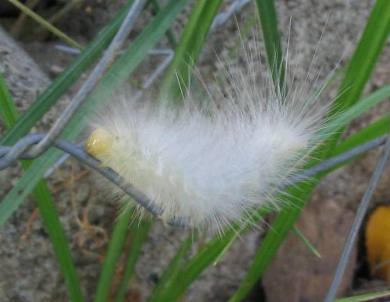
This little fella was as bright white as I've ever seen a caterpillar (must
not taste too good - lousy camouflage!). It was racing around our veggie garden
one day, but didn't find anything tasty, so it decided to leave. It may be an albino yellow woolly
bear moth larva.
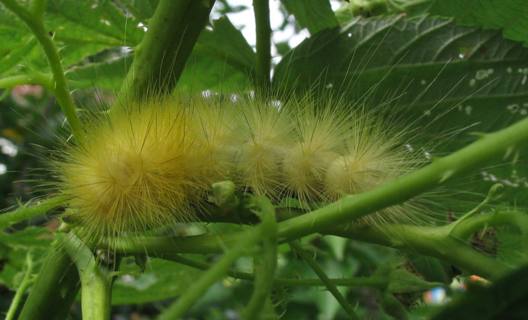
This one is even hairier, and not quite as white. While the one above looks kinda
cute, this one looks fearsome!
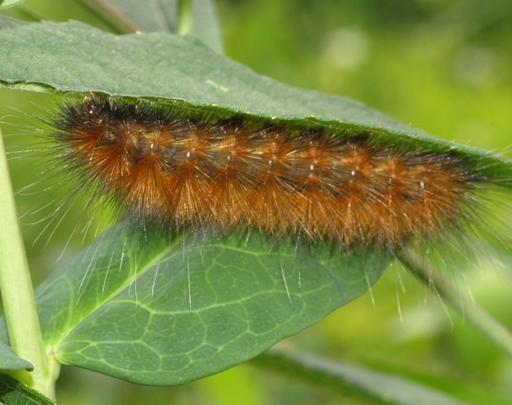
This, I've been told, is the caterpillar of the Virginia tiger moth
(Spilosoma virginica), whose adult form is mostly white with a few
black speckles. Its caterpillars are often called yellow woollybears (see more
examples above).
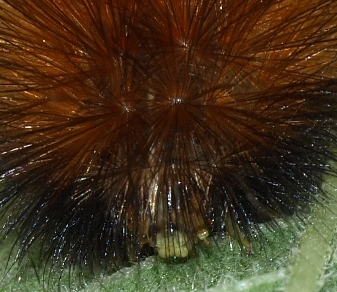
How do you like its bitey bits?
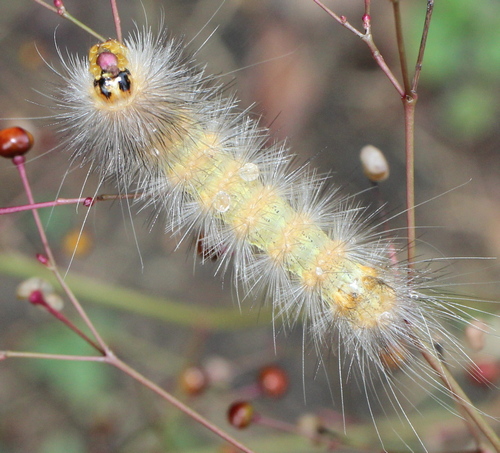
With a wild mane and impressive biting parts, this
caterpillar reminded me of a diminutive lion – but it is in fact a
youngster of the salt marsh moth (Estigmene acrea), helping itself to a
few bites of jewels of Opar (Talinum paniculatum). The adults are
strikingly patterned moths, with orange abdomens and white wings spotted
irregularly with black – but I have yet to see one.
Texas, May 2022
Pictured here are just two of a whole cluster of
caterpillars hanging out on the underside of a branch on our flowering plum
tree. They are larvae of the gypsy moth, which is native to Eurasia. They
were introduced into the United States in an attempt to use them for silk
culture. After they escaped captivity, they have been spreading across the
United States, where they do considerable damage to forests. Penn State
University fact sheet
|
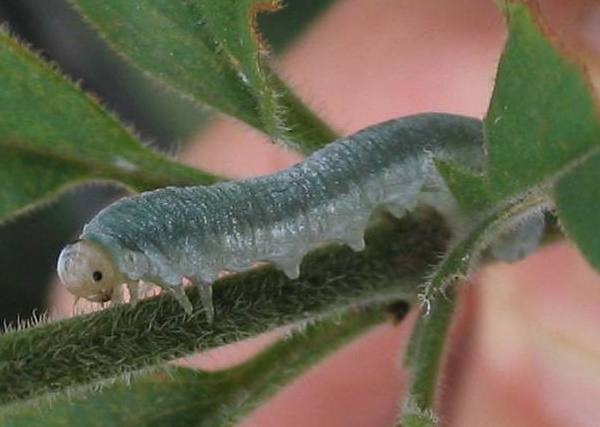
When I found a zillion of these guys decimating my Lysimachia
punctata, I had hopes of benevolently sustaining an interesting
butterfly or moth population. Turns out I had a bunch of larvae of the
sawfly species Monostegia abdominalis on my hand – sure enough,
they feed exclusively on loosestrife. With their blue-gray coloration they
were quite the fascinating creatures.
|
|
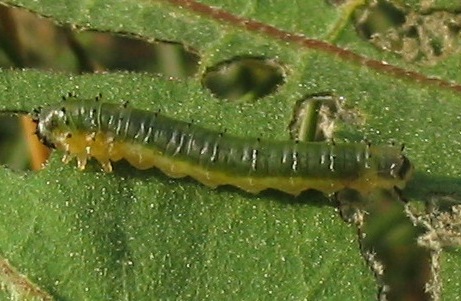
Sawfly larvae sure are a destructive bunch! This time it was the
hardy hibiscus that was skeletonized, by who other than young'ns of the hibiscus
sawfly (Atomacera decepta).
|
|
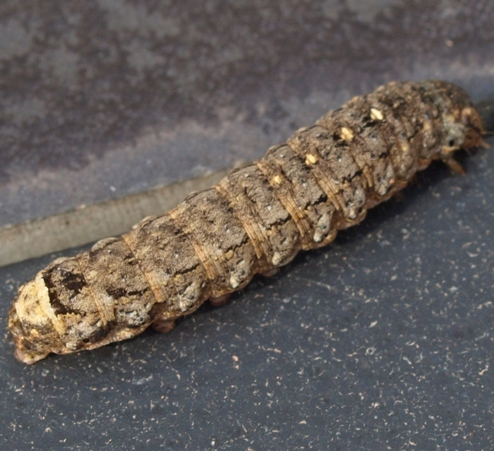
Intricately patterned caterpillar. As it turns out, it's a
bad guy, at least as far as gardeners are concerned: the variegated cutworm, offspring of a brownish moth also known as
the pearly underwing. Widely distributed across North America and Eurasia.
|
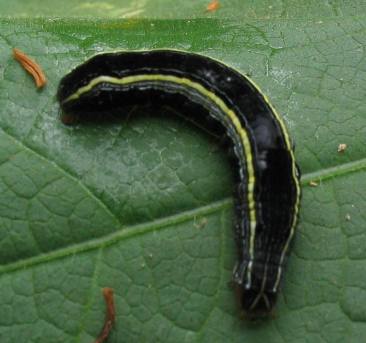
Striking velvety caterpillar with bold coloration, most likely a yellow-striped
armyworm (Spodoptera ornithogalli), which grows into a not quite so bold-colored
moth.
|
|
|
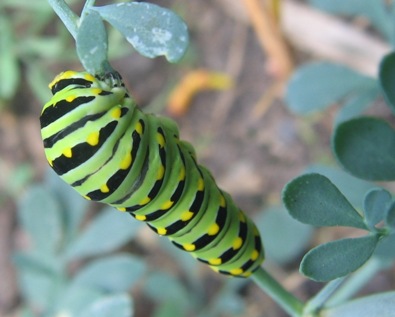
Young'n of the black swallowtail (Papilio polyxenes). Although the adult
would be considered more beautiful (judge for yourself at my butterfly
page), baby is kinda handsome in its own way.
|
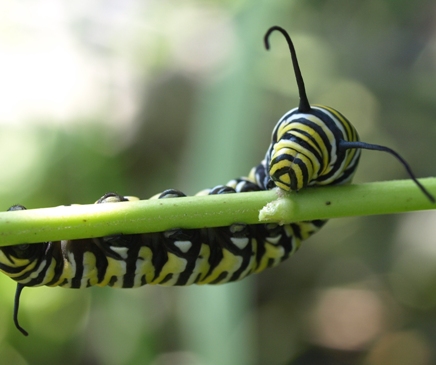
Munching on milkweed (in this case, swamp milkweed, Asclepias incarnata) just
like it should, this was our first monarch caterpillar sighting of 2009, on
August 1st. The little fella is playing a game of peek-a-boo!

Found this fur-footed gray caterpillar on some ruellia on a
nice day in spring. It was destined to grow up into a tussock moth, but I never quite
found out which one (the dot-lined white, Artace cribrarius is among the
possibilities.
Texas, April 2022
|
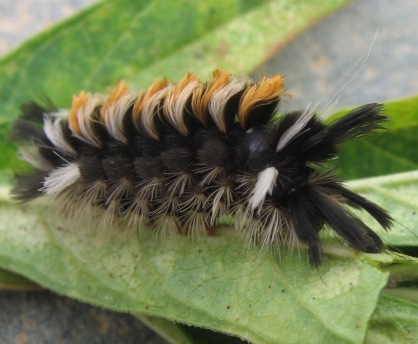
Wow dude! Nice do! Found this one on a milkweed plant, and sure enough, it's
the caterpillar of the milkweed tussock moth (Euchaetes egle). From
what I've read, it's common to find plants just crawling with these caterpillars,
I only saw the one. |
|
|
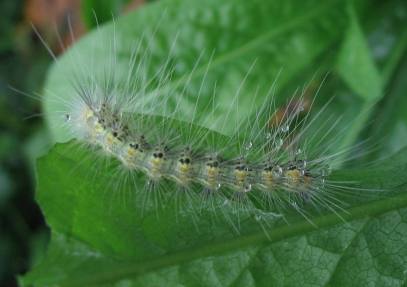
Found this one crawling on a devils-bit scabious (succisa pratensis). It's a
fall webworm (Hyphantria cunea),
probably in its last travels before pupation, after growing to its largest
caterpillar form inside a silk web shared with its many siblings.
|
|
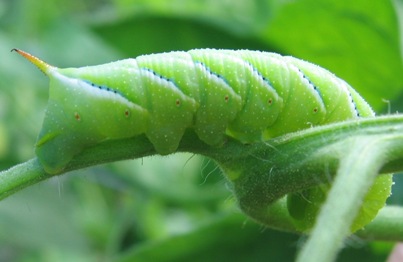
Since our tomatoes are mostly spared destruction by tomato hornworms (Manduca
sexta), I actually find the sporadic sightings quite interesting. Pardon
the picture of its back end - but the horn is really its most photogenic part.
The adult is a greyish-whitish moth, not nearly as exotic-looking as its
babies.
|
|
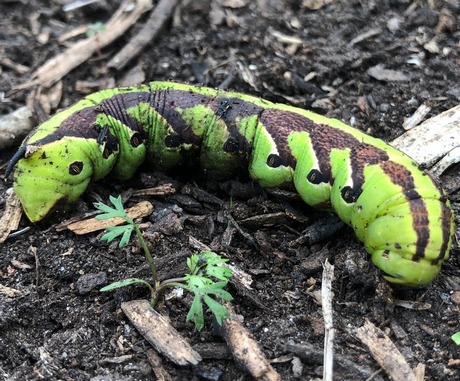
This dandy is another hornworm, this one of the sweet-potato variety,
which hopes to grow into a pink-spotted hawkmoth one day. I found it roaming
on our community farm plot, where indeed we had grown sweet potatoes (I had
recently harvested them and removed the abundant foliage – quite likely
dislodging this chomper from its food source.
Texas, November 2021
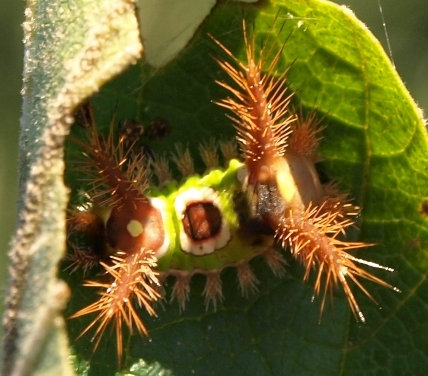
Nifty small saddleback caterpillar (Acharia stimulea), aspiring to grow
up to be a smallish black moth one day.
It was probably a hitchhiker on a tree we purchased at a nearby nursery.
Supposedly its sting packs a punch - I opted not to put it to the test.
Pennsylvania, September 2008
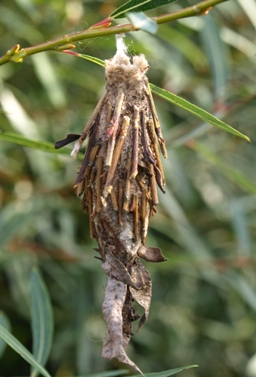
We see these little stick structures all around, but until recently didn't
know who was responsible for them. Another type of moth, it turns out: bagworm
moths (family psychidae) build these surprisingly tough dwellings out
of silk and plant debris. The larvae live there for a long time, emerging only
to eat.
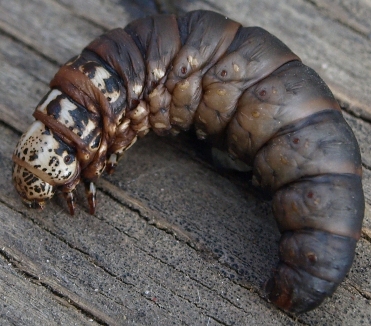
Multi-legged ones
Centipedes and millipedes, that is. Centipedes have one pair of legs per body
segment, millipedes have two pair. I usually encounter these ground-dwelling
critters while digging around in my soil, and seldom have a camera to operate
with my grimy hands - so not so many photos. But here are a few, anyway:
|
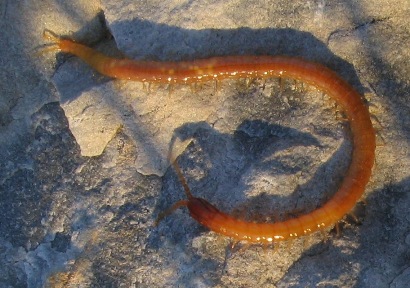
I'm amazed - I found this guy (a soil centipede) sneaking through my clay soil,
and relocated him to a rock to shoot his picture. He's perfectly clean - my
dirt doesn't stick to him. Why don't my kids have that useful property?
|
|
|
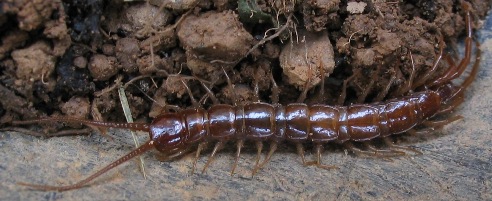
Fewer segments and legs on this one, but just as shiny. This stone
centipede, in the lithobiomorpha order, was also crawling around in
our soil. It was identified as Lithobius forficatus on BugGuide, based
on specific antenna and segment plate (tergite) details.
|
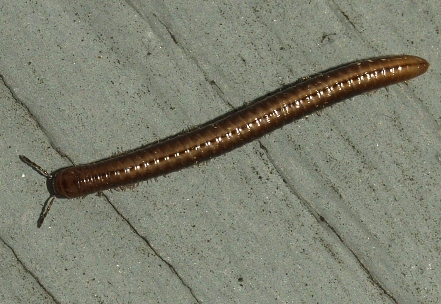
Even more legs - although I won't vouch for a thousand. Some kind of
millipede, anyway.
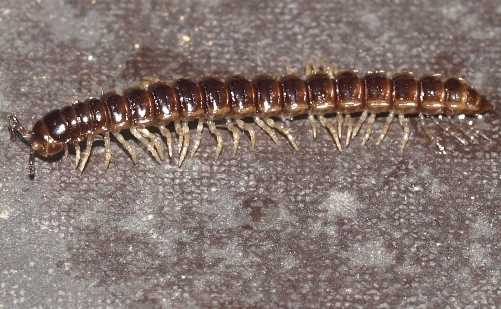
This is most likely a greenhouse millipede (Oxidus
gracilis). Native to Asia, it hitchhiked into North America and is now
common in all of the continental United States. This one had taken refuge
in some curly endive harvested from the garden one day in early July.
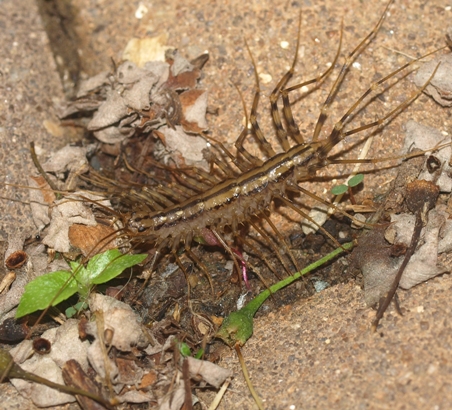
I found this thing of beauty in our kitchen sink one day
– the sides were just a bit too slippery for it to crawl up and out,
which is probably a good thing, because I can only imagine the screams of terror
that would have ensued had my dear wife or daughter come upon it in a less
confined area. In any case, I dispatched it to our patio, and later learned
that this is a house centipede (Scutigera coleoptrata), apparently
quite common, even though it's the first one I recall seeing in nearly 20
years of living here.
Visitors to this page have left the following comments| Polina | Feb 25, 2006 | WOW ! very informative ...and i like those pics of ur nephew , so cute !! can see that u put a lot of effort in it so
KEEP IT UP ! |
| Ashley | Sep 03, 2007 | I love the pictures of the caterpillars (destructive as they might be). Some of them are really beautiful. And beware the stone centipedes. They can deliver a nasty bite. My dad found this out the hard way. I narrowly missed a painful bite to a bare foot just recently. |
| Mich (pronounced: Meesh) | Jul 20, 2008 | I love insects and gardening. I was looking to ID a caterpillar (of the white wooly kind)that was munching kohlrabi leaves in my garden. Alas, my insect books showed me nothing conclusive, and in my computer search I came across your site. Beautiful photos! Fun and interesting commentary. Your respect and curiosity about these diverse creatures comes through. Insects (and arachnids) are amazingly wonderful. |
| Paul Brubacher | Nov 24, 2008 | You have an interesting web site. Thank you for sharing.
I've seen a skinny white worm that looked like a thread. Any idea what this was?
Some kind of nematode? |
| fellow animal lover | Feb 28, 2009 | Beautiful photos! Love the little stories with them :)
I have recently come across a green caterpillar with tiny black dots along its body...I found it in some lettuce.
Any ideas on what it might be? |
| Alice in wonderland | Mar 02, 2009 | Don't you find them a bit gross when their in a group? can you help me with my project? I have to find facts about the Milkweed Tussock Moth caterpillar and I can't find much information about them.
I'd only do the same as you - search online for information sites. Good luck! |
| cari | Aug 07, 2009 | I've also had the bluish,white,gray sawfly larvae decimate my yellow loosestrife for several years - do you have any suggestions for how to reduce or eliminate them? I like the lysimachia punctata but it's very short lived once these larvae get to them. It was all of two days this year and I've got nothing but skeletal remains. (Cdwalquist@aol.com) |
| gclef | Aug 10, 2009 | I think I have an army worm on my celosia flowers. Should I be worried?
Just pick any caterpillars you find off; insecticidal soap should work OK too. |
| Rocky | May 25, 2010 | A great piece of information for everyone who is fond of the colors of nature. I will refer this site to the children of my school.
Thanks... |
| gardening in philadelphia | Sep 04, 2010 | like many of the others, I cam e across your site while trying to identify 'visitors' to my garden. Seems I have a full scale invasion of White Woolly Moth and Army Worms - Surprised about the latter which I was sure would become a butterfly as it is not at all hairy. I thought all moth caterpillars were hairy?! Any who - i don't have the heart to kill them but as cat rule my garden the birds are doing nothing to tame the population so I will collect and release elsewhere...
|
| Shahin | Mar 17, 2011 | I actually have a question. Do the soil centipede damage the dirt and plant roots, or do they work like regular soil worms who are beneficial to plants?
I've not heard of harmful effects from these centipedes - so I consider them a normal (and possibly beneficial) part of the biological environment of my garden's soil. |
| devon | Oct 24, 2011 | i have a pet black and red-orange woolly bear and can send you a pic
What an interesting choice of pet. Lately, I've seen lots of woolly bears - riding the rural roads around here on my bicycle, it's like a slalom race trying to avoid them. |
| Heidi | Aug 28, 2012 | Thanks you helped me to identify the catapillar I found in the yard. 😃 |
I welcome comments about my web pages; feel free to use the form below to
leave feedback about this particular page. For the benefit of other visitors
to these pages, I will list any relevant comments you leave, and if
appropriate, I will update my page to correct mis-information.
Note that I discard any comments including
html markups, so please submit your comment as plain text. If you have a
comment about the website as a whole, please leave it in my
guestbook. If you
have a question that needs a personal response, please
e-mail me.
Last modified:
December 31, 2024
Contact me
|