 |
Garden journal |
 |

Brave Sir Reptilot |
July 21, 2025. Magical quests
Sir Reptilot found himself engulfed in a magical forest, all misty yet surrounded by an eerie glow. Curiously alive branches and vines pressed in on him from all directions, seemingly ready to pounce and ensnare him. Lesser reptilians would have lost heart and turned back in defeat, but not Sir Reptilot: our undaunted anole hero ventures on, ready to slay the evil creatures he is certain to encounter and by this act fulfill his noble quest. Not once did he suspect that he was the star in an action adventure taking place in the ancient fiefdom known to some as the Lush Gardens of Richmond, in the wild borderlands of the Kingdom of Texas. But his audience was certainly charmed.
Comment on this journal entry |
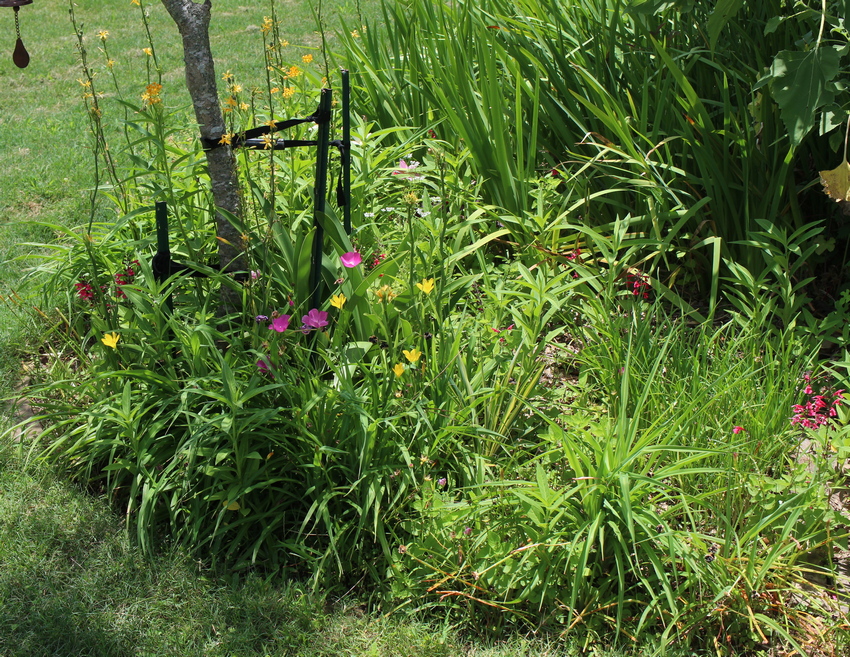
Lots of little flowers |
June 19, 2025. Late-spring abundance
After a rainy finish to spring, the garden is in active growth. Not many new flowers or plant features to report, but the growth spurt has many of the old familiars blooming simultaneously. Take the foundation border lobe, pictured here. The showy amaryllis are long gone, but the poppy mallows are still going strong, as are the red salvias and a few red rain lilies to round out the reds and purples. On the yellow-to-orange spectrum, the Texas crag lilies have fired up their show, and volunteer tropical milkweeds are putting in a strong performance this year. The yellow rain lilies finally decided to bloom, the last zephyranthes to do so in our garden this year, while Z. dichromantha has already finished its second flush. Yet to bloom are the Texas onion and the pink fairy duster – and hopefully a few more surprises. Overhead, the hardy tapioca tree has finished blooming, but is growing its round seed pods, which I hope will reach maturity this year; they've fallen off prematurely in previous years.
Comment on this journal entry |

The blood lily's Houdini act |
June 07, 2025. The case of the missing blood lily
Five years ago, I purchased a single bulb/plant of African blood lily and planted it in what was then the right fence border. It proceeded to bloom in its spectacular fashion shortly afterwards, and since then it's put in a performance every year. It has the distinction of being the last of my perennial plantings to show itself in spring, in most years waiting till mid-late May to display signs of life. But this year, May came and went and still no Scadoxus sighting, even though I had been looking closely at that general area as the month progressed. The year following its introduction to our garden, I undertook the project to make our rock garden zone, which connected the waterfall pond, the small rock garden, and the right fence border – and in doing so, I had planted a young whale's tongue agave not too far from the blood lily. Today, in another scan of that part of the garden, I suddenly noticed the lily in full bloom, its stalk bent at an unusual angle. Following the flower stalk down to the soil, I found that it disappeared underneath the agave. Turns out that the agave, no longer so young, has grown so much that one of its lower leaves blocked the lily's attempt to surface. Luckily, the lily was resourceful and found a way to display its glorious flower – and having done so, alerted me to its distress. To makes its life a little easier, I cut away enough of the agave leaf to uncover the bulb's point of emergence. That set free the flower stalk, but more importantly also the beginnings of the foliage that follows flowering and recharges the bulb for next year's floral spectacle. In time, I'll probably need to relocate the lily, but I think it will be OK for the remainder of this year.
Comment on this journal entry |
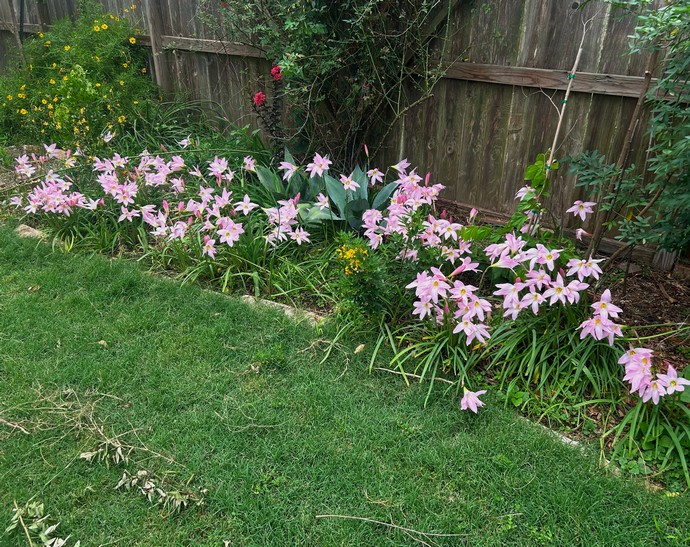
Habranthus robustus blooming abundantly |
May 30, 2025. Post-thunderstorm bounty
After at least three weeks with no rain and hot weather, we got a nice drenching set of thunderstorms roll through after Memorial Day. Sure enough, that kicked many of our rain lilies into gear. It's amazing how quickly they send up flowers after a good storm; I guess they have buds eagerly waiting below the soil, ready to jump as soon as the time is right. Most of our rain lily varieties had already gone through a flowering stage earlier this spring, but many of those repeated for this event, which had the garden richly decorated in Habranthus and Zephyranthes blooms: Z. drummondii, Z. dichromantha and Z. katheriniae put in abundant repeat performances. Z. macrosiphon, which had only put out a few flowers earlier this spring, was absolutely stunning in clumps around the garden, and H. tubispathus bloomed for the first time. The same goes for H. robustus, whose broad area of self-seeded clusters seen in the photo here burst into simultaneous flower along our left side border. The only ones not playing along were Z. morrisclintii, which had bloomed earlier this year, and Z. citrina, which has yet to bloom. These flowers will last only a few days, but I appreciate them while they last – and look forward to the next good thunderstorm that breaks an episode of dry heat.
Comment on this journal entry |
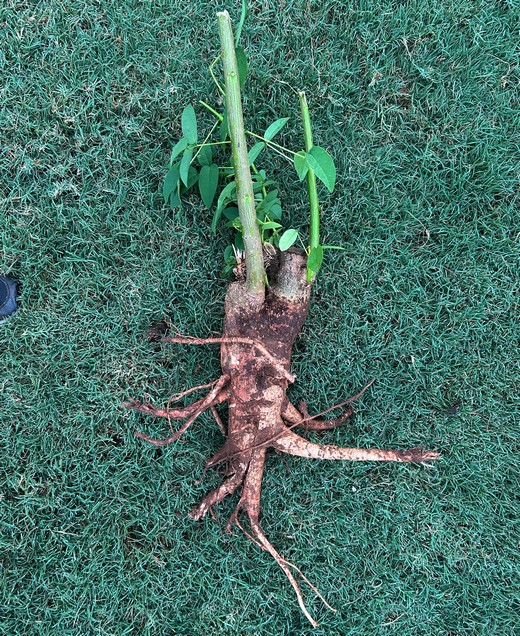
Robust underground growth on our Erythrina crista-galli volunteer |
May 27, 2025. A stubborn coral bean
I have an incentive to make the garden look extra nice, and keep it looking that way: we'll be hosting a family event in the backyard next year, and this is the trial year to see if we can keep things looking perky through a Houston summer, to provide a charming backdrop for our guests. So I've been keeping busy, taking greater care to rid known problem areas of troublesome weeds, getting rid of misplaced plants that I've allowed to grow where I know perfectly well they shouldn't, and just generally trying to picture what the garden could look like, and trying to get it there. One goal is to provide a greater sense of seclusion to our fenced-in backyard, hiding most of the fence. I got there once a few years ago, but freeze- and hurricane-induced tree and shrub losses opened up some new gaps, and the goal is to extend the tapestry above fence height, to hide more of the neighboring homes. One conspicuous gap is in the back left corner of the yard, where I took out a struggling fig last year. Another fig is still doing well there, but the other shrubs in the vicinity aren't tall enough to obscure the fence, let alone the neighbors' house – so Amy set me a challenge to come up with some taller things to grow there. So this week, I transplanted a sucker from our abundantly growing Lespedeza 'Little Volcano', which will fill in part of the backdrop. For the other, I had in mind a volunteer coral bean, which had seeded not far from its mother plant a couple years ago. It was definitely one of aforementioned misplaced plants, as it was growing towards the front of the border where its thorns were likely to cause problems (and snag those prospective guests), so I was intent on moving it to the gap area, closer to the fence. It wasn't a particularly large plant, so transplanting should be easy – or so I thought. I soon found out it would be a more significant operation: when I tried to lift it, I found that the plant arose from an underground stem about six inches in diameter (much more robust than the above-ground growth), which extended quite a ways into the soil. And that soil wasn't easy to dig into, after several weeks of hot and dry weather. So I spent a couple of hours painstakingly excavating soil from around an ever-increasing hole a trowelful at a time, periodically soaking the hole to give said trowel more purchase in the hard clay. But even after all that effort, the darn thing wouldn't budge even a fraction of an inch when I tried to get a shovel underneath it or to dislodge it with both hands. Finally, in frustration, I laid down on the ground next to it and kicked it as hard as I could. Luckily, that did it: it gave a fraction of an inch, then an inch, and then yielded enough for me to get at the roots below holding it so firmly in place, allowing me to finally extract it. The photo here shows what it looked like with most of its top growth removed to facilitate the digging operation. After snapping its picture, I set it in its new home, where thus far it seems to be doing OK, despite the rough treatment it got. With some luck, it will zoom up high above the fence by this time next year, much like its momma already does right around the corner.
Comment on this journal entry |
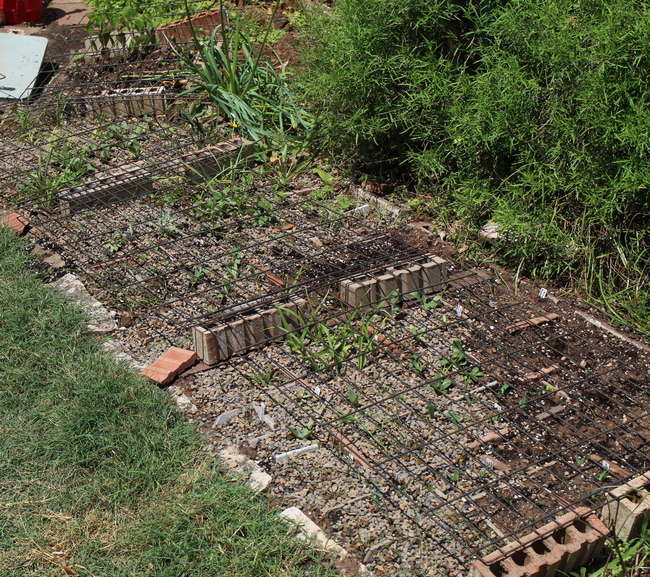
panels across four seedling beds |
April 21, 2025. Dog block attempt #43
My regular readers (do I have any of those?) will remember that my gardening efforts are routinely thwarted by my two beloved but destructive dogs, Hippie and Birdie. Their havoc they wreak is especially devastating in my seedling nursery area, where every dog pawprint in recently watered soil can easily take out a number of my carefully raised seedlings. I've previously shared a few of my attempts to minimize the damage they do, such as this fencing-out strategy from 2023, which used the attached-together panels of a portable dog enclosure to build a vertical barrier to exclude the girls. While that was somewhat successful, it also made it rather difficult for me to tend to those nursery beds, resulting in rampant weed proliferation and ultimately quite low seedling survival. So, hardly a success overall. The following year I tried to be smarter and erected a chicken-wire fence from house to side fence, aiming to exclude the dogs from the entire section of the side garden. It made for awkward mowing, but more disappointingly, Hippie and Birdie are athletic creatures, and found the barrier to be an interesting but not very challenging obstacle in their running-around-the-yard endeavors. It was perhaps a partial success, since they did seem to spend less time in the seedling beds. But I was still hoping for something better. So cue up this year's new and improved strategy: those same metal grate panels, now separated from each other, arranged horizontally across individual sections of the seedling area, held aloft by some bricks. So far, I like it: the girls aren't inclined to traverse the covered areas, much like cows don't travel across cattle grates, while the seedlings can grow right through the panels, so they are not particularly bothered. To access one of the nursery beds, for setting out some more seedlings or clearing some weeds, I just need to lift a single panel off of its supporting bricks. Gardeners are an optimistic bunch, and I'm full of hope that I've found the best solution yet!
Comment on this journal entry |

Canned flowers |
April 01, 2025. Slightly messy wildflowers
Last Christmas, my daughter's girlfriend, knowing about my gardening hobby, gave me a can of wildflower seed mix as a thoughtful present. She's not a gardener herself, and lives in a rather different part of the country from me, so I wasn't sure how the seeds would fare in our Houston garden; the seeds were "packed for 2022", so their viability might have declined, but I decided to give them a try nonetheless, distributing them in two swaths of our front-yard borders, which had some extra room after I enlarged them last year. Sure enough, in late winter some plantlets started popping up; by late March, they formed a dainty little carpet of low-growing wildflowers, visually dominated by the baby blue eyes (nemophila) and tidy tips (layia), both annuals that will disappear once the heat of summer arrives. So the display is ephemeral, but quite charming while it lasts – and I'm on the lookout for some different blooms to chime in between now and summer.
Comment on this journal entry |

Flower power! |
March 30, 2025. Simply overwhelmed
A couple of years ago, after the most severe among the winter freezes of recent years killed off the satsuma oranges growing behind our pond, I planted a redbud to replace it. Not just any Eastern redbud (like the one we had grown back in Pennsylvania), but specifically the Texas variety, purchased at a local native plant nursery, because of its greater suitability to our Gulf Coast climate. From its dead-stick appearance upon purchase, it has done rather nicely, despite being viciously attacked by bagworms at some point last year – but thus far it hadn't bloomed. So I've been on the lookout this spring, and lo and behold: there it was, a flower at last! Following this stupendous display of color, I'm hoping for even bolder performance next year. What do you think, is it even possible?
Comment on this journal entry |
January 26, 2025. Snow day
Since moving to the Houston area nine years ago, it's snowed twice (not counting slushy-freezy weather events), and this past week certainly qualified as the snowiest I've witnessed. The week continued the pattern of recent years where considerably colder than average freeze snaps take swipes at the Texas Gulf Coast: there was a string of five nights of freezing temperatures with a low of 20°F on Tuesday – once again threatening all those tropical plants our nurseries keep selling. I kept my protective efforts simple this year, wrapping only my lime and mandarin orange trees in protective fabric (with colorful Christmas lights underneath as a source of some warmth). Many other plants, including recently purchased ones, may have perished; I won't know for sure until signs of life present themselves (or not) in early spring. But it sure looked pretty! This photo of our backyard pond was taken while the snow was still coming down pretty hard, so we accumulated a bit more. Our dogs had never seen snow before, so they enjoyed the new experience. And by now, a few days later, the snow is all gone and we're back to typical Houston winter weather (with an overnight low of 60°F!). It's all very exciting when these cold snaps hit, but I must admit I wouldn't mind returning to a climate where it's a given that killing freezes will happen every year, and people garden accordingly...
Comment on this journal entry |
Journal entries for previous seasons
2004
2005
2006
2007
2008
2009
2010
2011
2012
2013
2014
2015
2016
2017
2018
2019
2020
2021
2022
2023/4
Last modified:
July 21, 2025
Contact me
|
