Four-winged huntersWe've seen lots of dragonflies and damselflies in our garden through the years. These fascinating creatures are in the insect order Odonata, whose ancestors flew (in much larger sizes) among the dinosaurs. Some of them seem to never sit still, forever zigzagging the outline of their territory. Others are more accommodating to my camera - their pictures can be found on this page. The dragonsDragonflies (suborder Anisoptera) are the larger of the two, grand
flyers with robust bodies and large eyes that together span most of the
width of their heads. When at rest, their wings are spread apart.
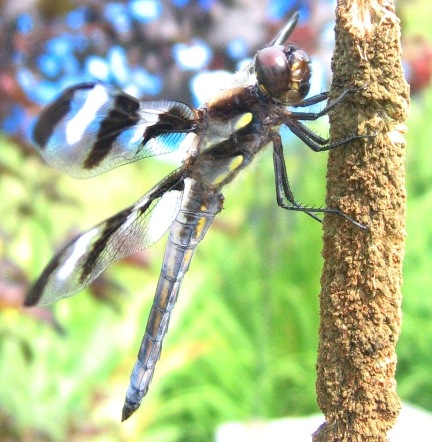
This twelve-spotted skimmer (Libellula pulchella)
shows off its white and black wingspots, perched on a fading cattail. The
white spots only appear on mature males of the species.
Another twelve-spotted skimmer. This one kept returning
to perch atop the little bean teepee we built in Max's garden.
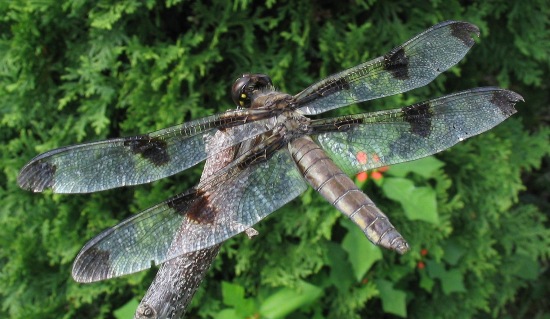
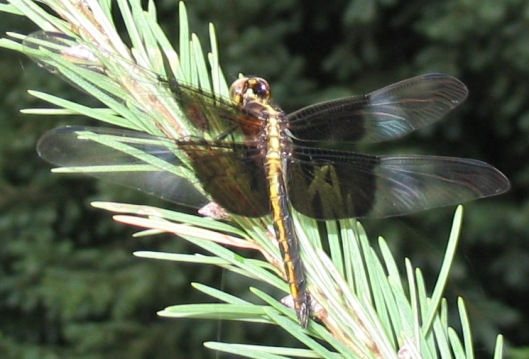
I've been told this is an immature male widow skimmer (Libellula luctuosa). He stuck around for a while, long enough for a photo op.
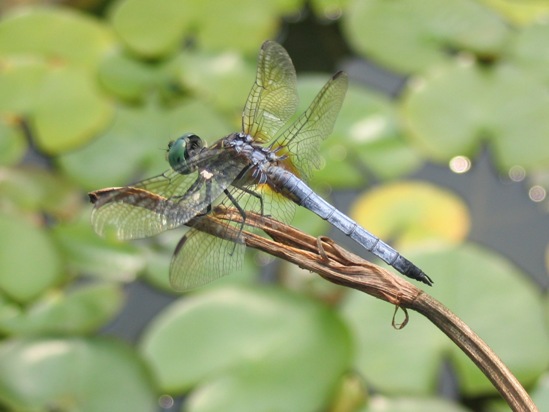
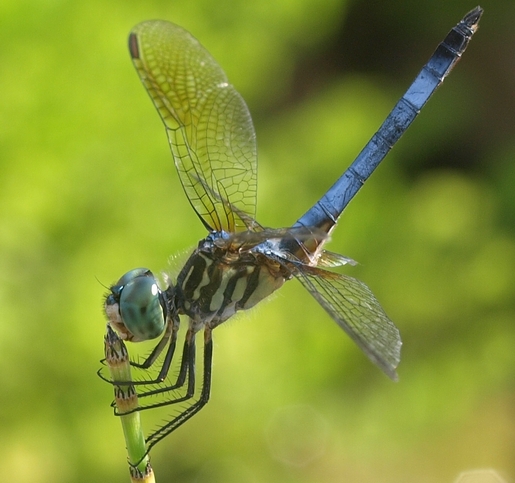
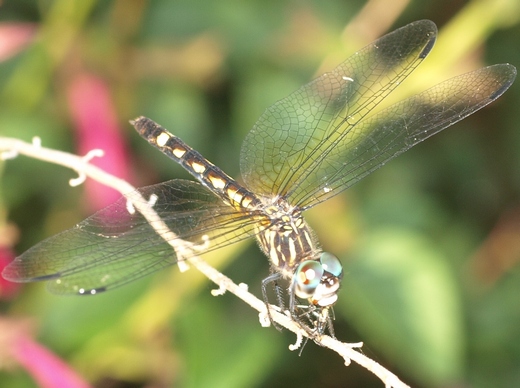
Blue dashers (Pachydiplax longipennis) are common
throughout the US, so we've encountered them both in our Pennsylvania garden
(photo at right) and in our Texas garden (below). Both photos are of male
specimens, which develop the characteristic blue color of their abdomen. They
like perching on spikey vegetation that gives a good view of the pond –
a spent iris stalk at right, and a horsetail below.
And here's a female, with rather different coloration
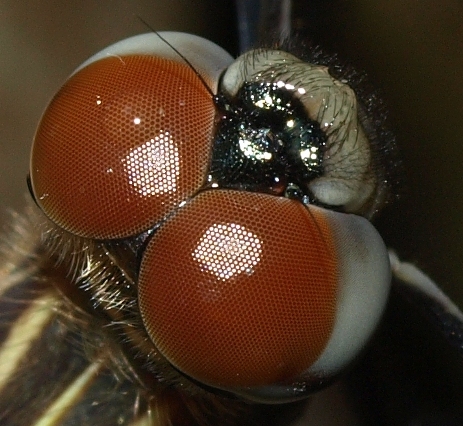
A marvel of biological engineering: the minutely faceted
eyes of insects. Especially when the insect in question has big googly eyes,
like this newly hatched blue dasher. I never expected the close-up photograph
to come out this clear, but I must admit I'm proud of it.
Thornbush dashers (Micrathyria hagenii) are smaller
dragonflies, whose range includes Texas and Mexico. Their distinguishing
features include bright blue-green eyes and black abdomens with white markings.
They often hold their wings angled downward when at rest.
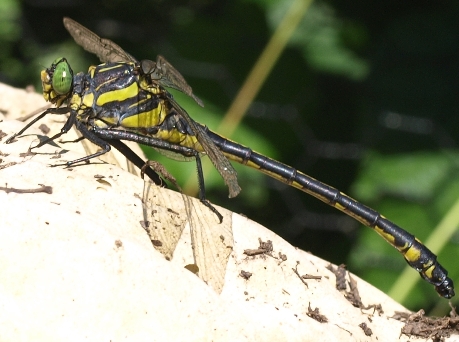
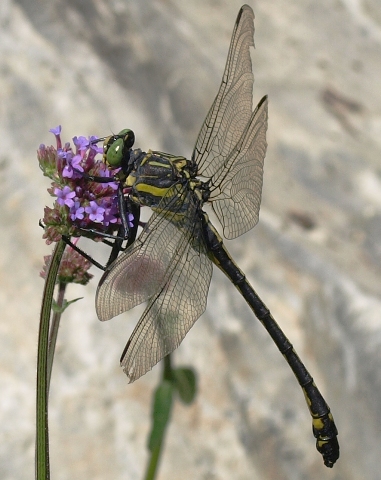
The two photos below are of the same individual (he wouldn't sit still,
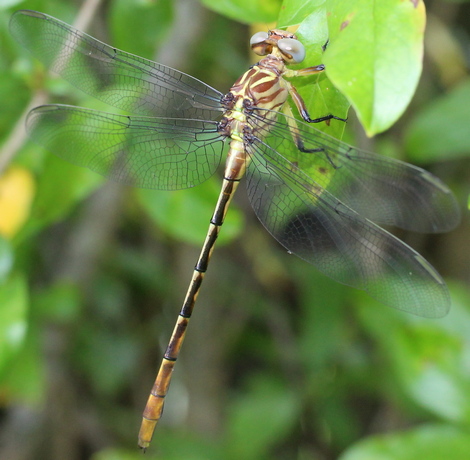
hence the different perches). It's a dragon hunter (Hagenius brevistylus),
one of the largest dragonflies I've seen in the garden. I spotted him on one
of the big rocks adjacent to our big pond one sunny late-summer afternoon; when
I kept trying to take his picture he eventually buzzed off to the neighbors'
yard.
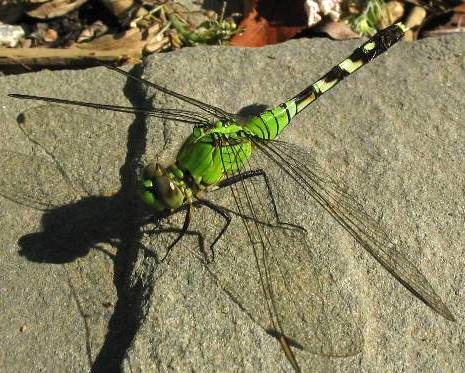
This female Eastern pond hawk (Erythemis
simplicicollis) stopped by one morning to warm herself on our flat-rock
pathway. She didn't stay long, and I haven't seen her or her kin near our
pond. That first sighting was in Pennsylvania, I've since seen this species in
our Texas garden as well.
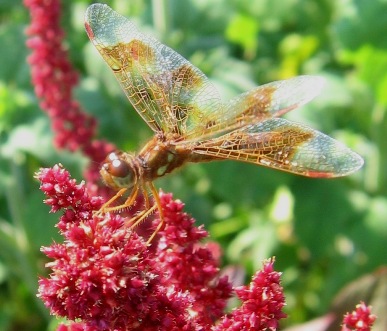
When I first spotted this female Eastern amberwing (Perithemis tenera) flitting about our cutting garden, I thought it was a spreadwing damselfly – it was smaller than other common dragonflies in our garden. But closer up, it was clearly a dragon. The way the light hits the wings in this photo, you can't discern the patterning – if I see her again, I'll try to get a top view shot.
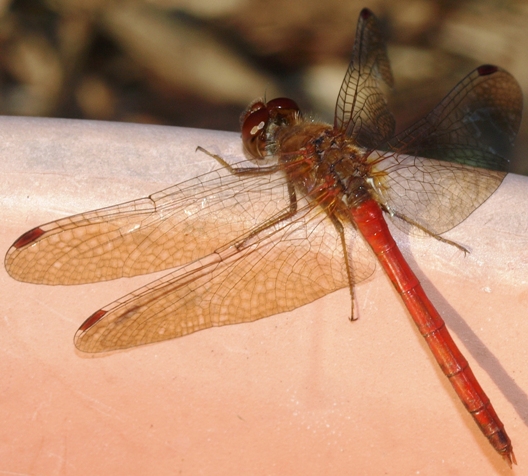
This male autumn meadowhawk (Sympetrum vicinum) was sunning
himself on the edge of a pot one late-October day. My only other siting of this
species was also on a sunny day in late October, so the autumn part of their
name is appropriate.
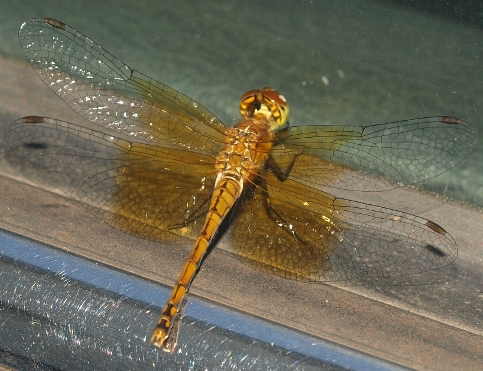
Staying with the meadowhawks for a moment, I found this
eastern band-winged meadowhawk female (Sympetrum semicinctum) one early
Sunday morning on my car. Not at all inclined to fly at such an hour, she
allowed me to take some good photos, even though the background isn't nearly
as nice as a pond full of lilypads.
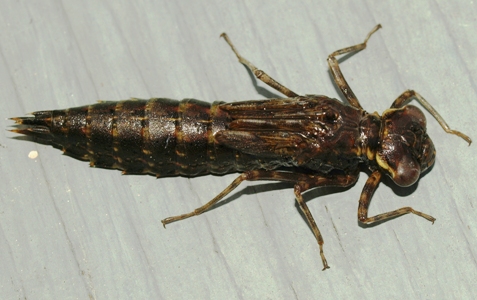
Now that we have a large pond with fairly clear water, we get
to enjoy the whole life cycle of dragonflies. My boys found this advanced-stage
larva halfway submerged on a rock one day (I'm proud - they were swimming, yet
they didn't freak out; instead, they caught the bug for papa!). It's most
likely a common green darner (Anax junius). See the little wing
stublets on its back?
The first new-to-me dragonfly sighting in Texas didn't happen
until a few years after we moved here. I see some species familiar from
Pennsylvania regularly, and am aware of some others that never sit down when
I'm looking so that I haven't had a chance to identify them. But this one, it
turns out, is a russet-tipped clubtail (Stylurus plagiatus). According to
Bugguide, its season runs from June through October, but this photo was actually
taken in mid-May, so it starts earlier in the more southern reaches of its range,
which spans from the eastern US through the southwest and perhaps into Mexico.
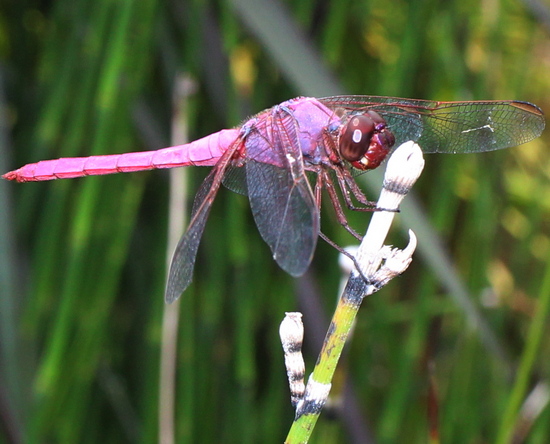
A new dragonfly sighting is always exciting, and this one
was particularly satisfying: large and with striking coloration, this is a
male roseate skimmer (Orthemis ferruginea), majestically holding court over
our pond, occasionally chasing away some common blue dashers but mostly just
ignoring them. He clearly had our pond as its base, making excursions into the
wider backyard but always returning to a few perches around our small water
feature. A bit skittish, so I had to wait quite a while for a good opportunity
to take his picture – but he finally sat still for me. Apparently quite
common through North and Central America, but I hadn't noticed this species
before.
DamselsDamselflies belong to the other suborder, the Zygoptera. Compared to
their dragon cousins, they are more slightly built, and have their eyes well
separated on their heads. Most damselflies hold their wings together when at
rest (but not all, as you can see from the spreadwing further down the page).
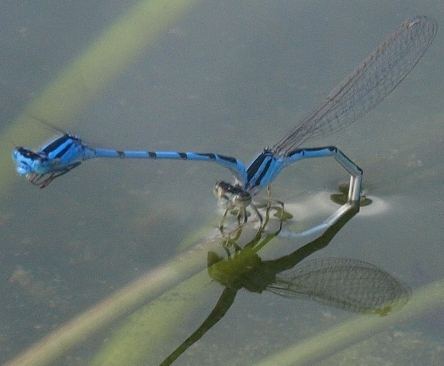
While wading chest-deep in our pond one day, busily
scooping out algae, all of a sudden I saw them – a pair of
bright blue damsels. I rushed back inside, leaving a drippy trail
across the kitchen floor, to get my camera. I'd never ventured into the pond
with my pricey digital SLR before, but I really wanted to capture their
mating dance, flitting from lilypad to lilypad, the lady depositing her eggs
under water in each spot. Watching them was more fun than fishing for algae!
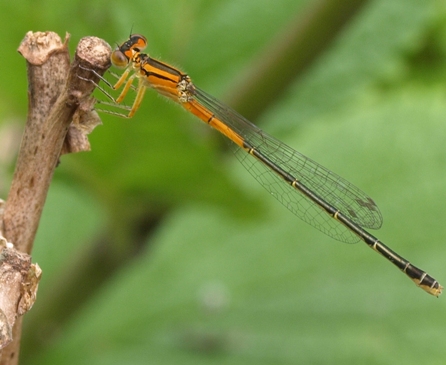
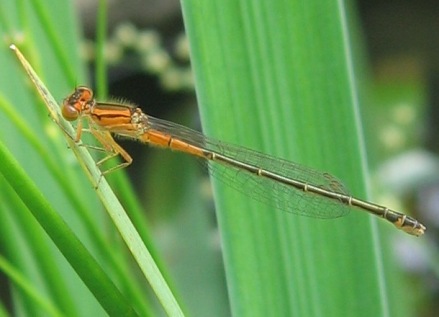
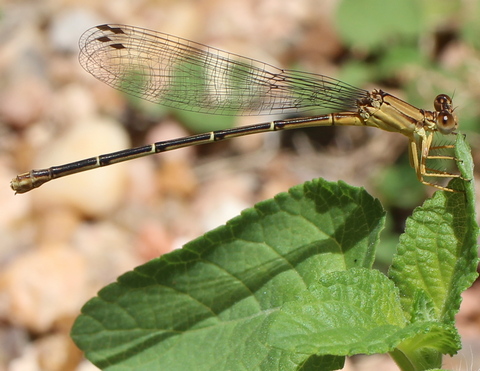
This orange-bodied side-eyed beauty was hovering ever so delicately through
the flowers alongside our bog filter in early August. I first thought it was
an orange bluet (Enallagma signatum), but that one has an orange
tailpiece. Which means this is an immature female Eastern forktail (Ischnura verticalis).
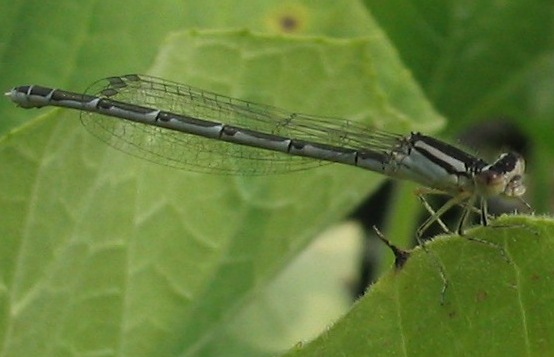
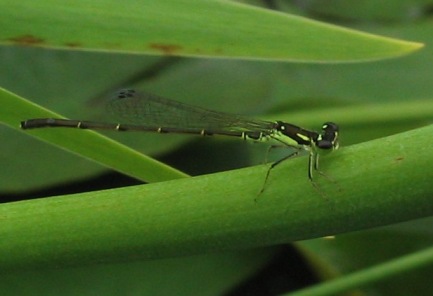
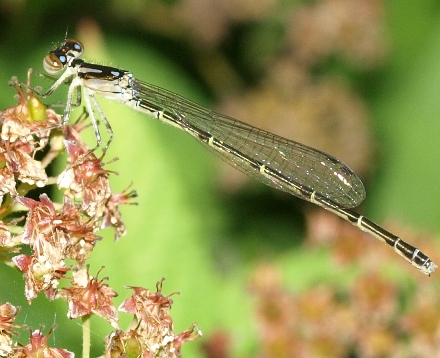
Another bluet pond damsel, this is a female, either a marsh bluet (Enallagma ebrium) or Hagen's bluet (Enallagma hageni). She was hovering all around our fading tomato plants in early September.
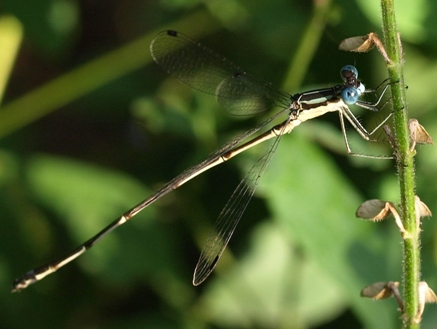
This damsel took me by surprise – it was a good bit bigger
than most of the ones shown above, so at first I thought it was a dragonfly.
Turns out this is a slender spreadwing damselfly (Lestes rectangularis):
it holds its wings spread out when it rests, instead of together like most of
the others.
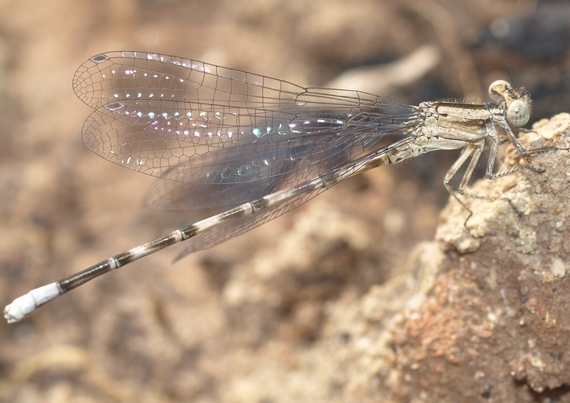
Taking the prize as the first damselfly I found in our new
Texas garden, this Kiowa dancer (Argia immunda) is an immature male
that hasn't yet developed the rich blue color that it will sport later in life.
The species occurs mostly in the southwestern US. Compared to other damselflies,
it holds its wings upward, above its abdomen. I'm looking forward to seeing him and his kin develop, as our garden should
start attracting damsels and dragons now that it features a pond and a good
number of plantings. I'll be on the lookout!
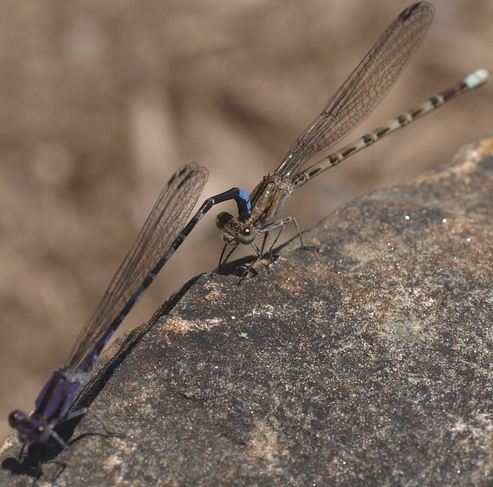
Since that first sighting, I've seen plenty more Kiowa dancers. This one
is an older male, which has developed its purple and blue coloration.
And a few days later, I spotted this mating pair flying around our pond,
alighting on rocks and vegetation between their graceful stints of joint
flight.
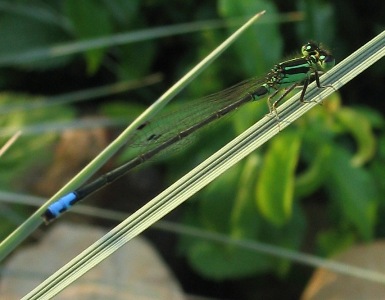
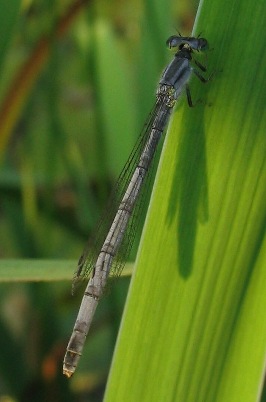
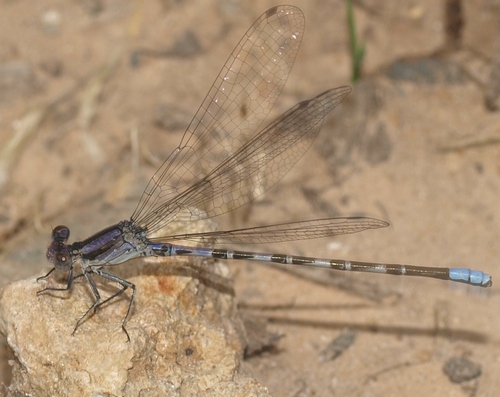
Their cousin, the blue-fronted dancer (Argia apicalis) visited us in September a few years after that Kiowa dancer sighting. Despite its common name, this species is variable in color, with the ability to change its abdomen tip from blue to dark grey, the rest of the segments being dark brown. It is widely distributed across North America, where its habitat is usually areas around fresh-water bodies surrounded by woodland. Texas, September 2021
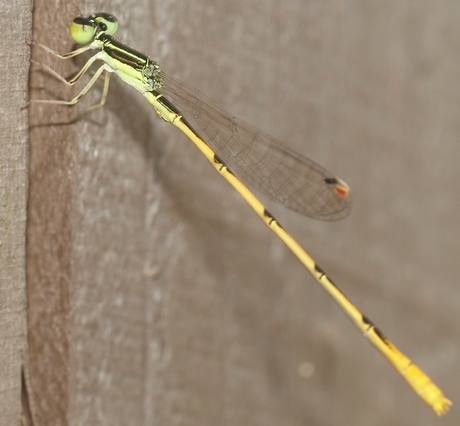
I was so used to seeing only Kiowa dancers in our
backyard, I figured this whispy thing that hovered near my Job's tears was
just another color variation of that species. But it turns out it was a
citrine forktail (Ischnura hastata), the smallest of the U.S.
damselflies, readily identified by its yellow tail. Even though its range
is large and includes all of the eastern U.S., I had never spotted this one
in Pennsylvania.
Reportedly the most widespread forktail in the Americas,
Rambur's forktail (Ischnura ramburii) hadn't appeared on my radar screen
until well into our tenure in Texas. This one has the coloration typical of
males of the species. It is commonly found near stagnant or slow-moving bodies of water,
which describes our backyard pond pretty well.
Visitors to this page have left the following comments
I welcome comments about my web pages; feel free to use the form below to leave feedback about this particular page. For the benefit of other visitors to these pages, I will list any relevant comments you leave, and if appropriate, I will update my page to correct mis-information. Note that I discard any comments including html markups, so please submit your comment as plain text. If you have a comment about the website as a whole, please leave it in my guestbook. If you have a question that needs a personal response, please e-mail me.
Last modified:
June 19, 2025 |
||||||||||||||||||||||||||||||||||||||||||||||||