 |
Flying with two wings |
 |
Flies and mosquitos are categorized in the insect order diptera,
which refers to the fact that they have only two wings (most other insects
have four).
Until I started paying attention, I never knew quite what variety of
flies there are, even in my own back yard. Some of them resemble
houseflies, but many are more wasp-like in appearance. Some buzz around mightily,
while others are so tiny they're hard to see.
Insects, yum!
Flies' appetites vary. Some of the more interesting ones prefer to feed on
their fellow insects.
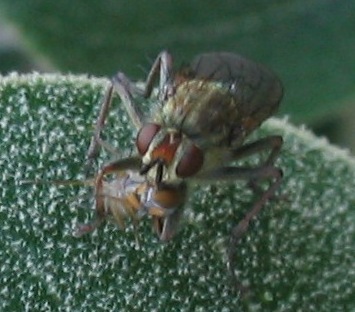
This predatory fly (probably a scathophagid) was carrying around a smaller fly. Since flies don't have
biting mouthparts, they can only eat liquid food. To eat its prey, it needs
to dissolve it in its enzyme-rich saliva. Bon appetit.
Pennsylvania, October 2004
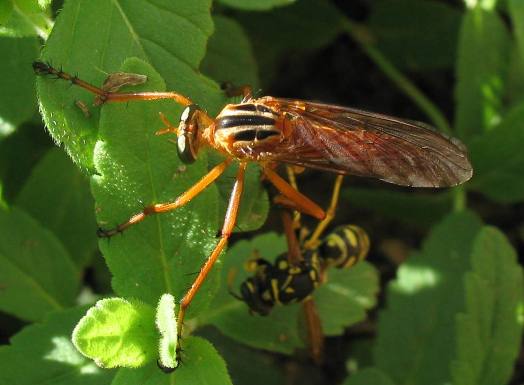
Robber flies hunt other insects for a living. This one is a hanging thief
(Diogmites sp),
named for the way it hangs from its forelegs while maneuvering its prey with
the remaining four. I'm not sure if
the wasp in the photo was its prey or just a bystander.
Pennsylvania, August 2004
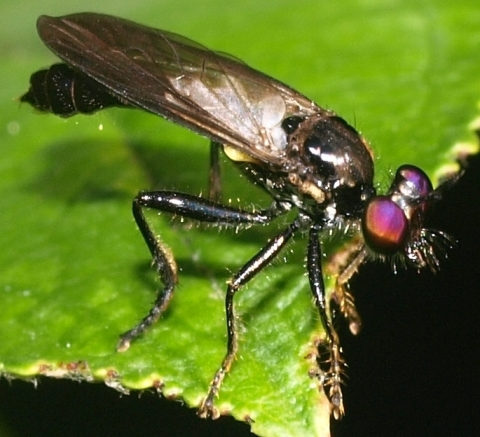
Another robber fly, this one a good bit smaller. It is most
likely Eudioctria albius. Its irridescent eyes looked like they were
different colors, depending on the angle from which they were viewed.
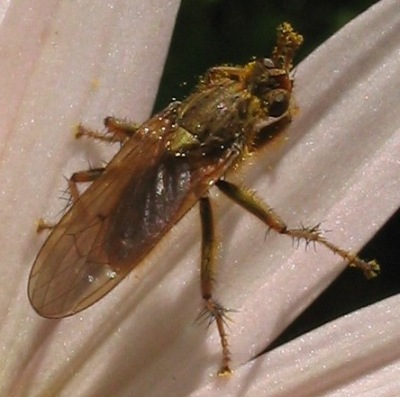
Yum, dung!
This golden dung fly (Scathophaga stercoraria) is grooming itself
with its front legs. This species occurs worldwide, laying its eggs in dung
of domestic and wild animals. Adults are predatory, mostly eating other
flies.
Humans, yum!
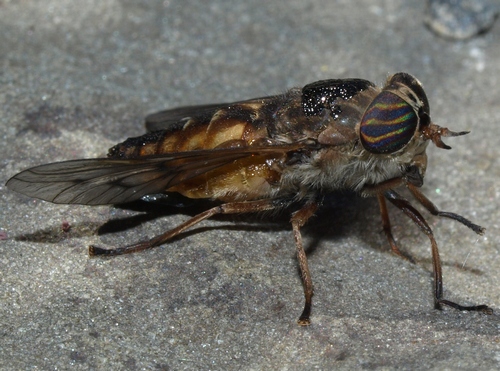
While wading in our swimming pond one afternoon in late spring, I was
viciously attacked, not once, not twice, but three times! The villain was
careful to stay behind me, out of sight, leaving me to lash out
indiscriminately at the perpetrator of the cowardly onslaught. Even so, one
of my defensive moves proved successful, and incapacitated my nemesis by
dousing its wings with water, leaving it flightless. Using footage from my
security camera, I alerted the authorities. I learned that the evildoer was
well known from previous offenses: it was none other than Ms. Hybomitra
Nuda, a horsefly who usually sticks to the northern parts of North
America. Having been defeated by my cunning countermeasures, she retreated,
and did not visit our Pennsylvania headquarters again.
Multi-faceted love
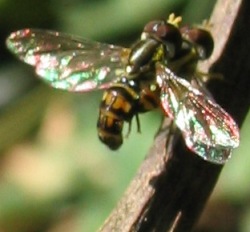
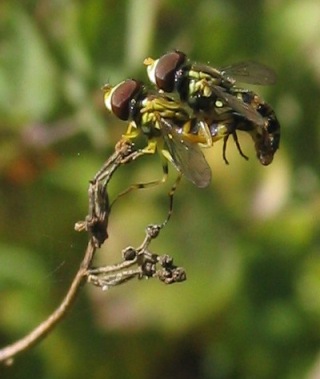
These two little syrphid flowerflies (probably toxomerus geminatus) were
inseparable, flying from one perch
to the next one sunny day in early October.
Pennsylvania, October 2004
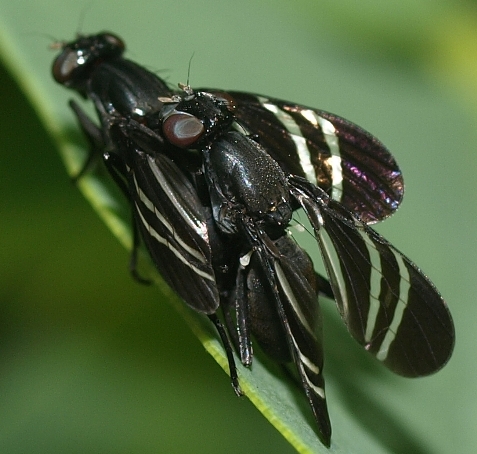
I spotted these black onion flies (Tritoxa flexa)
in the curve garden on an early evening in late June. They are supposedly
associated with cultivated garlic, but we don't grow any of that at the moment.
Perhaps they like Egyptian walking onions too – those we have in the veggie
garden.
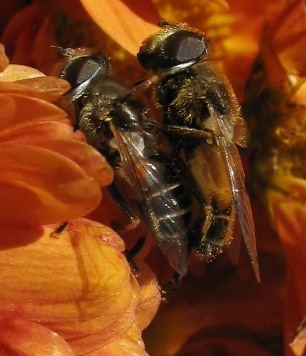
Late October is still a great time to procreate,
especially on a warm sunny day with a fragrant garden mum perch. While
these Eristalis arbustorum are larger than the ones above, they also
belong to the syrphid flies. The species is widely distributed in both North
America and Europe.
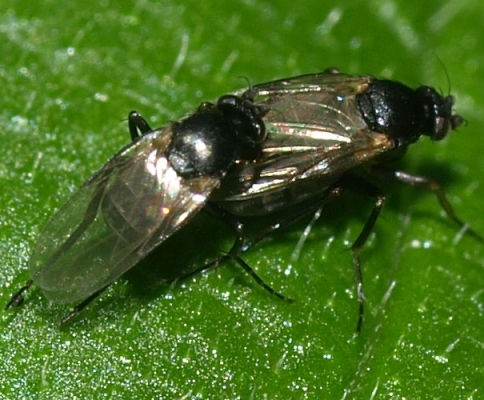
I found these scuttle flies (in the Phoridae
family) on an early-summer evening. The family has members all around the
globe, with thousands of species representing a great diversity of habitats
and food sources. These ones in particular have nice big clear wings. Not
commonly seen in our garden.
Tachinids and syrphids
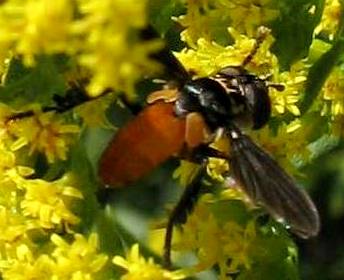
Tachinid flies feed on flower nectar as adults, but their younger stages are
parasites of other insects. This one, a featherlegged fly (Trichopoda sp.),
uses true bugs as its unfortunate hosts.
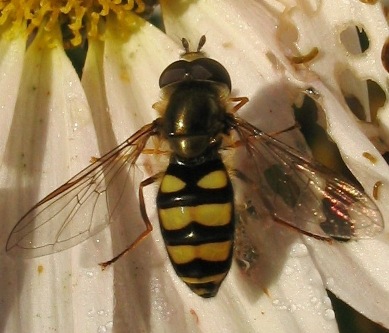
These syrphid flies, resembling small wasps, are quite abundant in the late fall,
here seen visiting a Sheffield mum.
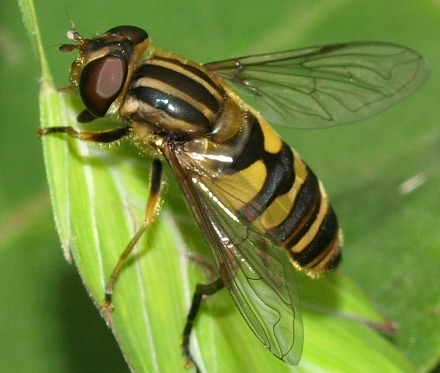
The patterning on this Helophilus fasciatus syrphid identifies
her as a girl-fly. She's lounging on a pendent panicle of sea oats (Chasmanthius
latifolium).
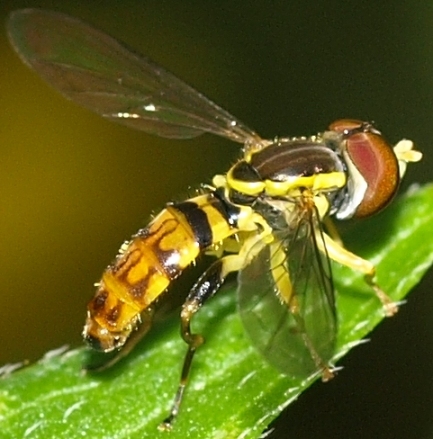
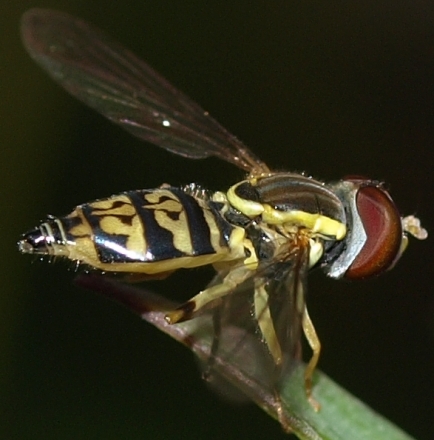
The most abundant syrphids in our garden are these little Toxomerus geminatus
flies, recognizable by the little keyhole patterns along the center of their
backs. The one at left is a male, at right a female.
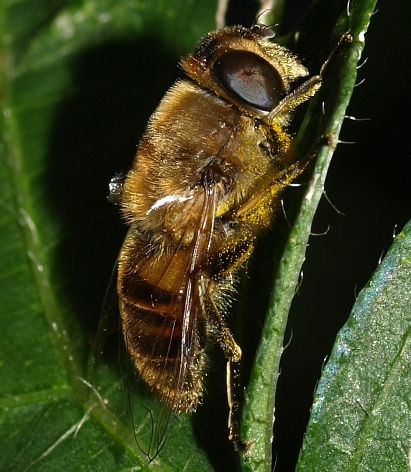
One cool October afternoon, I spotted this fuzzy insect
sleeping on the leaf of an Abelmoschus manihot. I thought for sure it
was a solitary bee, but upon closer inspection (and checking at BugGuide.net),
I found out it was in fact a fly that takes on a bee-like appearance for its
own evolutionary reasons: Eristalis tenax, the drone fly.
Conveniently, he remained motionless as I repositioned his bed this way and
that to take a few photos. Must have had a hard day going about its drone duties...
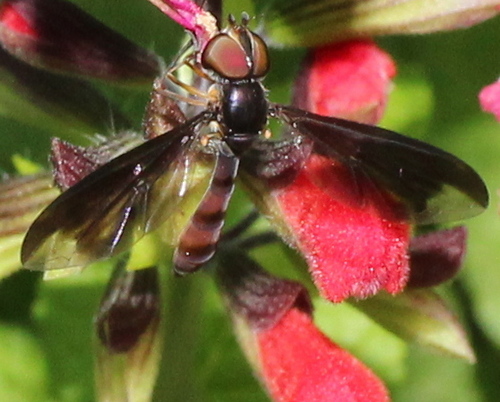
There are syrphids in Texas too! The one pictured here,
Ocyptamus fuscipennis is the first I managed to capture in action while
nectaring on some scarlet sage. It's supposedly found throughout North
America. So it's about time I spotted one!
Texas, September 2021
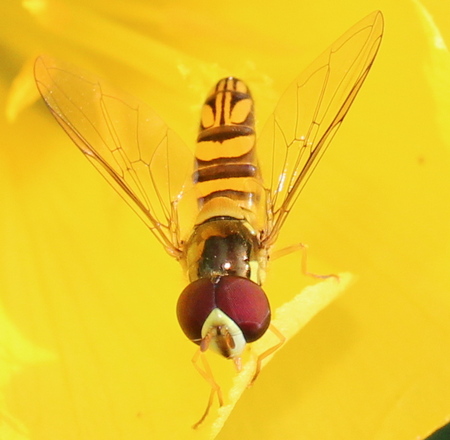
Presumably named for the markings on its back end that
look like firy rocket streaks, this little hoverfly goes by the common name
of oblique streaktail (Allograpta obliqua). It is apparently found
throughout North America, and in my garden took a liking to a yellow
buttercup (Turnera) flower on Christmas day.
Texas, December 2021
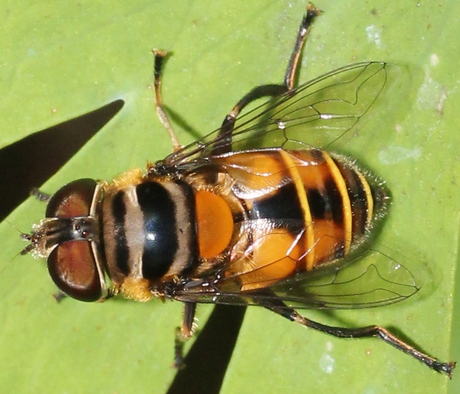
This dandy goes by the darling name of double-banded plushback
(Palpada agrorum). It is widely distributed through the Americas. This
individual was resting on a columbine leaf one late afternoon, and was not at
all inclined to fly away, even during my attempts at close-up photography.
Texas, May 2022
Blowflies
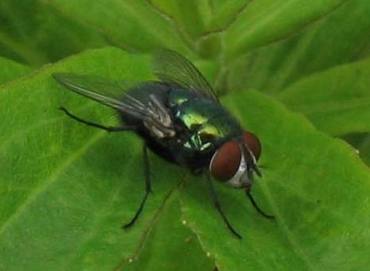
A small blowfly, probably the Lucilia illustris greenbottle. I see them
around throughout the season, usually on flowers.
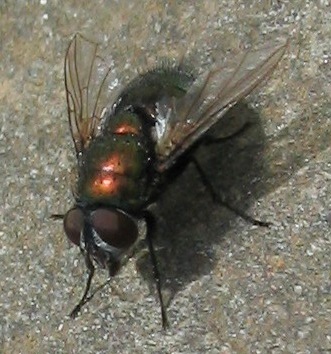
Here's another one, probably also in the Lucilia genus, just as
irridescent, but with more of a bronze coloration.
So many flies, most of them go without ID. Here's a sampling.
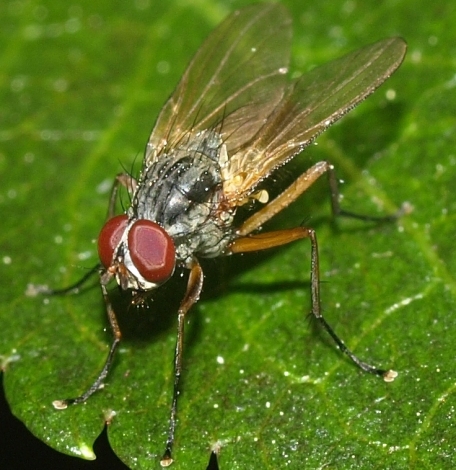
Many flies resemble the common housefly. Like this
brown-winged gentleman, who is a member of Muscoidea, and apparently
resembles Phaonia fuscana.
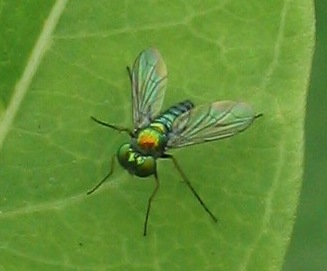
This tiny thing caught my eye because it's so shiny and colorful. A long-legged
fly in the dolichopodidae family, a species of Condylostylus.
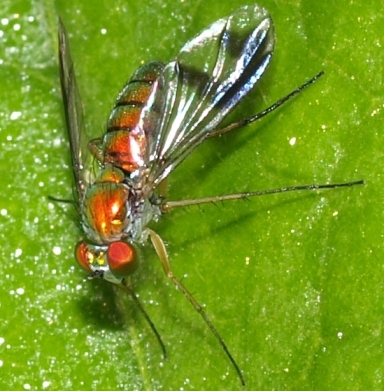
This one, also a Condylostylus, wasn't quite as small, and
more uniformly red in its metallic sheen.
Pennsylvania, August 2009
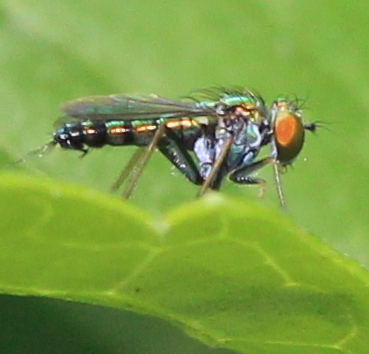
The long-legged ones appear in Texas as well (but they're
not Texas-sized – little here, too). This one is a Condylostylus
caudatus (or closely related), based on its golden-green coloration and
tapering waist.
Texas, May 2022
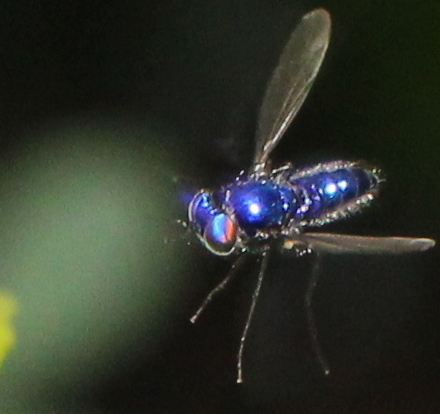
I particularly liked this one (a boy Condylostylus mundus), not
just for its bright blue coloration (which attracted my attention
from a distance, despite its diminutive size), but also for its behavior: I
took a number of photos, all of the little fly sitting on the same leaf. It
wasn't until I took a look at the snapshots that I realized that every time
I hit the shutter button on my camera, the silly thing jumped, so that I
caught it in mid-air. Which didn't make for the sharpest images, but it
brought a smile to my face.
Texas, May 2022
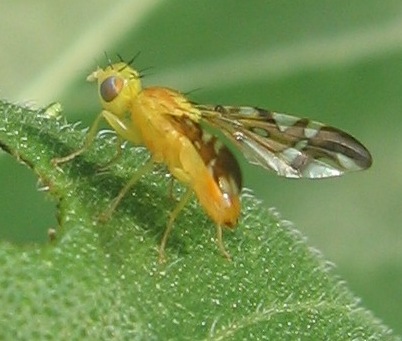
Several of these fruit flies (in the Strauzia genus)
were roaming the undersides of sunflower leaves for a few weeks in early summer.
I think of them as punk rock flies!
Pennsylvania, July 2005
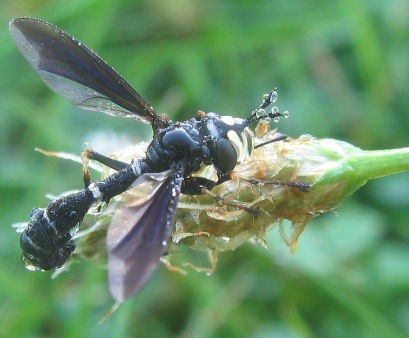
This is a thickheaded fly from family Conopidae, most likely a species in
genus Physocephala. They look like slender-waisted wasps, but their
wings give them away.
Pennsylvania, July 2006
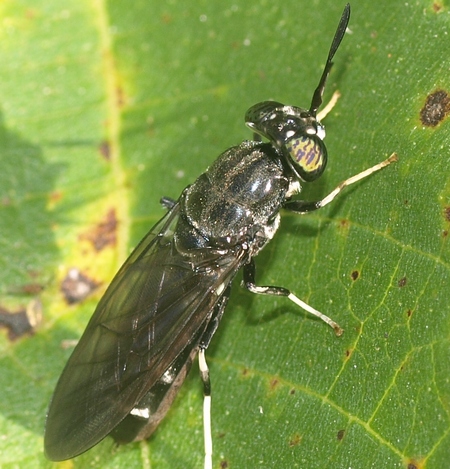
Not nearly as skittish as most flies I encounter, this
black soldier fly (Hermetia illucens) was quite fond of our fig tree's
leaves one October day. It mimics a wasp, which supposedly explains why it
makes a loud buzzing noise – but it was mostly quiet for me. Cool
green-and-purple eye pattern, don't you think?
Texas, October 2017
Bee flies
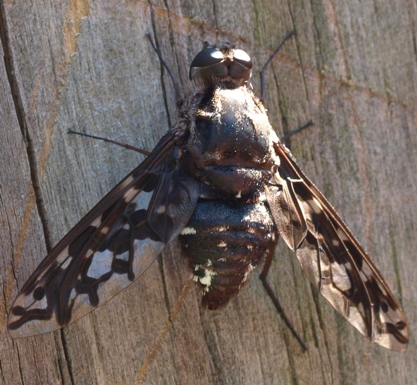
Bee flies are furry like bees, but their other anatomical characteristics
give away their flydom. The first time I noticed one, an impressive specimen
of tiger bee fly (Xenox tigrinus), it particularly attracted to me
and my shirt one day in August. The attraction wasn't mutual, but he looked
cool enough for me to take his picture. Since then, I've seen several more,
although I don't consider them common in our garden. The one shown here was
perched on the kids' swingset.
Midges and gnats
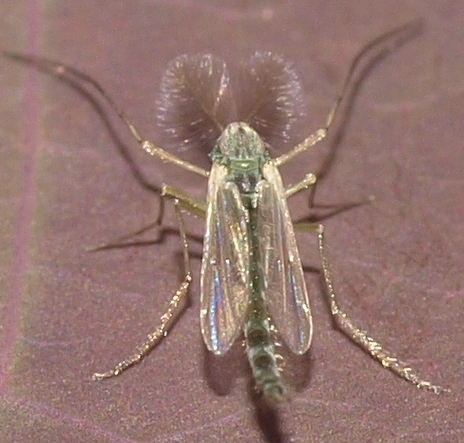
Midges are tiny little things – so small that I don't
typically notice them or take their picture. I should pay closer attention,
because up close they are fascinating creatures. Like this one, a male in the
Chironomini tribe, with marvellously feathered antennae and gilded legs.
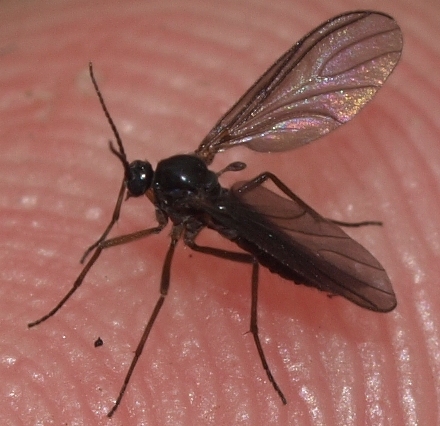
This small fly (no more than a quarter inch long - those
ridges are my fingerprint lines) is one of many species of dark-winged fungus
gnats, in family Sciaridae. Not sure what it was doing where I found it
(on our patio table in full sun) – they typically prefer damp habitats.
Mosquitos and such
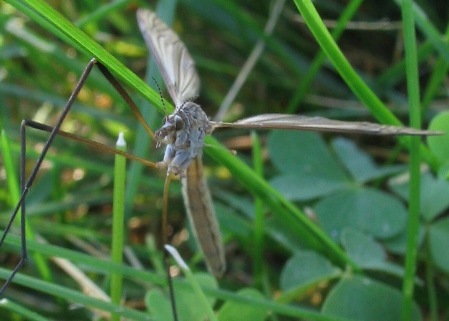
Looking like a huge mosquito, luckily this insect, a cranefly (Tipulidae
family) doesn't bite. Like mosquitos, though, it likes moist environments, and
its larvae are aquatic.
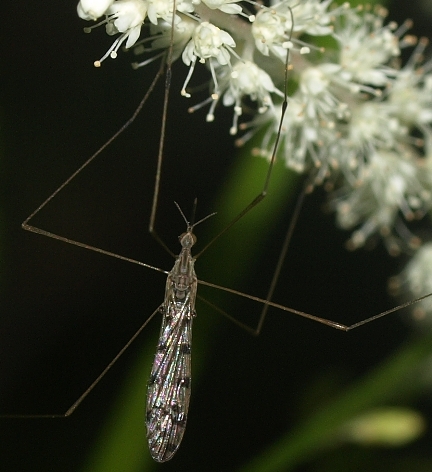
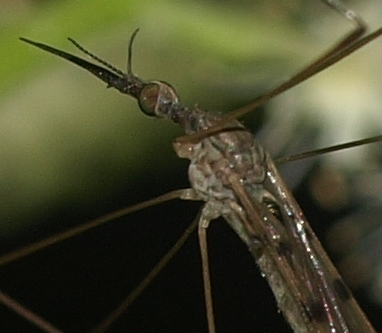
This meadow crane fly (Limonia rostrata) was quite
attached to a goatsbeard flower one June evening. In the close-up, its mouth
parts look quite impressive – good thing they can't bite humans.
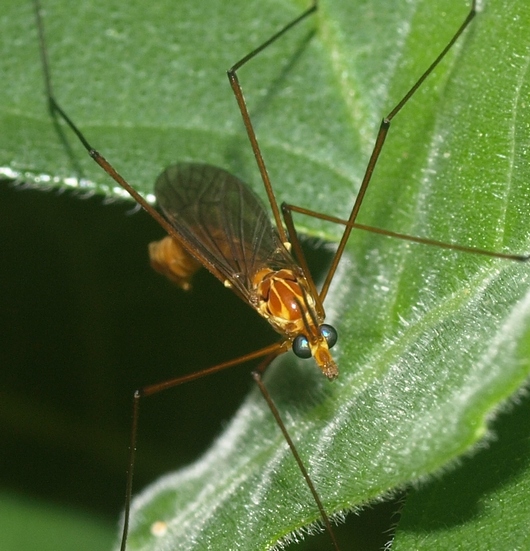
Texas is at the eastern-most edge of this tiger cranefly
(Nephrotoma wulpiana)'s range. I spotted it sitting in a fig tree one
afternoon – it was still there a few hours later.
Texas, June 2017
Visitors to this page have left the following comments| Alan | Oct 30, 2005 | Fantastic photos! Many of my 'close ups' are blobs & blurs. May I ask what type of camera you use?
Until this summer, I used a Canon A70. I now use a Canon A95, but find that it performs about the same in the close-up department. Canons in this series are known for their good macro abilities. |
| Jenn | Jul 18, 2007 | Hi- Great photos1 Also, do Tiger Bees bite? I have noticed a ton around my house lately... |
| noor vermeulen (the netherlands) | Jul 29, 2007 | about the huge huge mosquito(Tipulidae family) you mention its larvae are aquatic, maybe i don't understand that word correctly (in water?) but i think the larvae live in soil and feed on plant roots (damaging grass and lots of other plants).
We're both correct, as you can see at this page. |
| Tara | Sep 21, 2007 | Hey! Great shot of the tiger bee fly! I've noticed that everytime I see one of these guys they are attracted to people! Just like this one was hanging around your shirt... they always land on me- and hang out for a bit. I actually had one that would zoom right back to my fingertip everytime I'd flick it away- haha, like a circus trick! I wonder if it's the salt from our skin?? Anyone?? |
| Cheryl Lynn | Jun 18, 2009 | I did some research before making a trip to the Cook Islands, know for their ferocious human attacks. Luckily my local health food store owner knew just the ticket. Vitamin B1. That was it; take 100mg everyday for two weeks before the trip. I know that it worked because I forgot to take the vitamins with me and by the middle of week two, they were eating me alive! After I moved to Florida, B1 was a daily supplement. |
| reybo | Jul 26, 2009 | I came to see your photo and description of Bee Flies, and found the one who seems to be making a pet of me, the Tiger Bee Fly. Day after day he comes to visit when I'm on the veranda, and lands very close by. He stayed stationary against a white tile background for nearly an hour of mating, so I got some good photos. I'll try to upload one here. |
| Lisa | Jun 26, 2010 | Thanks for the picture of the Bee Flies, I live in Tennessee now and this huge bug kept circling around my daughter and I everytime we went out the front door! this had to be a good 2 inches from left to right! One of those bugs you just have to learn about. the pattern on the wings was very similar to the one pictured, but more squareish and the wings went a little more straight out to the sides I think this may be what we saw.
Do these flies bite? and if so, is it like a horse flies bite? I was very intimidated by it.
I don't believe they bite - at least, they've never tried their mouthparts on me. |
I welcome comments about my web pages; feel free to use the form below to
leave feedback about this particular page. For the benefit of other visitors
to these pages, I will list any relevant comments you leave, and if
appropriate, I will update my page to correct mis-information.
Note that I discard any comments including
html markups, so please submit your comment as plain text. If you have a
comment about the website as a whole, please leave it in my
guestbook. If you
have a question that needs a personal response, please
e-mail me.
Last modified:
November 25, 2022
Contact me
|
|
|