 |
Our garden's spider friends |
 |
Don't let my dear wife Amy see these pictures - she won't want to get anywhere
near the garden anymore. But spiders are so fascinating!
Orb weavers
|
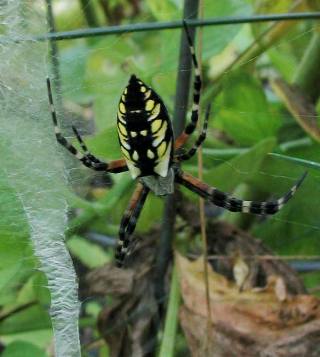
This black-and-yellow argiope (Argiope aurantia), or writing spider, was patiently awaiting
dinner among our tomato plants. Guess who's going to be harvesting the tomatoes
from now on?
|
| Brown-hairy with colorful markings, the Hentz orbweaver
(Neoscona cruciferae) is a traditional "scary spider". Very useful
in the garden, though, as it catches all kinds of other insects. The one pictured
at right lived in our driveway border. She had a nice web with traditional
layout, but spent the daylight hours hiding in a leaf on the outskirts
of her home (unlike the argiope above, who sits proudly in the center of
her web at all times). When disturbed, she runs to the center of her web,
and spastically shakes it about once a second, until she calms down.
|
|
|
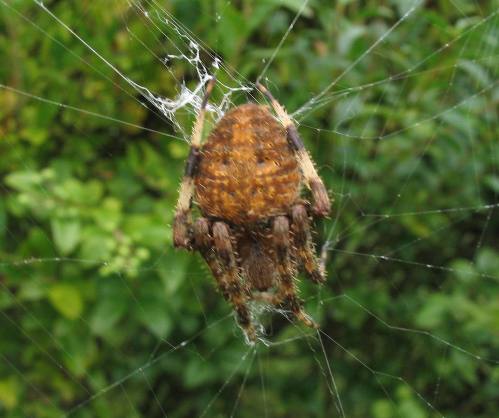
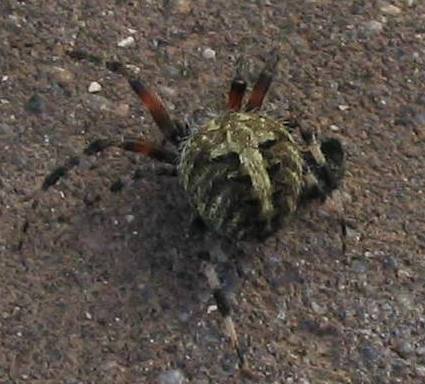
This spotted orbweaver, probably Neoscona domiciliorum, clambered
down my arm into my seed gathering bucket as I was collecting Thalictrum
flavum seed one day - I must admit I didn't particularly care for the
experience. After taking her picture, I gave her a new home in our garden.
|
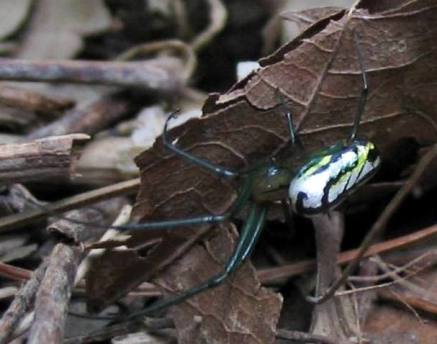
The Venusta orchard orb weaver (Leucauge venusta) is smaller than the ones above. The bright
coloration, so obvious in the photo, is easy to miss in a real-life encounter.
Fittingly enough, we found ours in the orchard area of our garden.
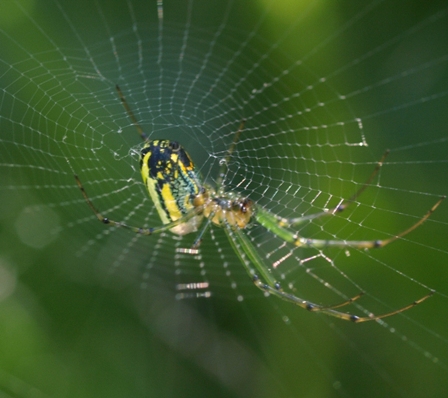
Here's another one, in a carefully crafted web this time.
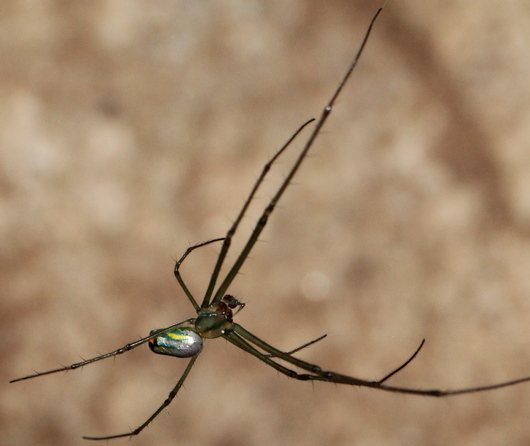
The family resemblance is clear in this Texas spider, this
one a Mabel orchard orbweaver (Leucauge argyrobapta> that had taken up
residence in the shady area underneath our backyard live oak. So orchard-like
conditions, anyway, although I didn't see an orb web. This species is common
through the East and Gulf coast states of the U.S., from Virginia to Texas,
and its range extends throughout Central America into Colombia.
Texas, December 2025
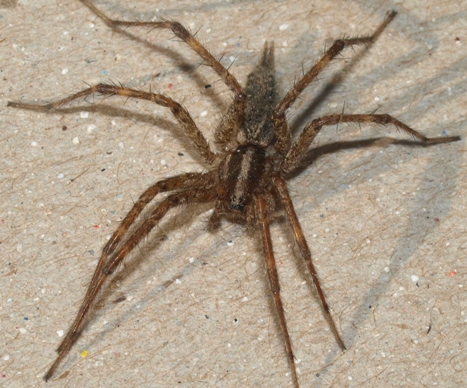
We've found this species of funnel web weaver, also known as common grass
spider (Agelenopsis sp.) both inside the house and outside –
they have a particular affinity for kids' plastic yard play equipment.
We're not sure they make good playmates, but these spiders are mostly
harmless to humans. They create a funnel-shaped web and wait in the center,
then pounce when their prey enters.
|
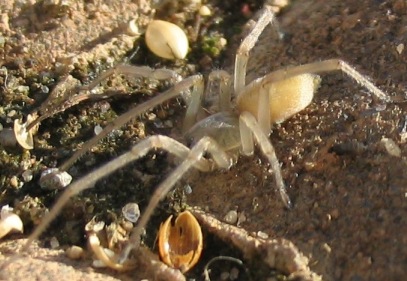
The longlegged sac spider (Cheiracanthium mildei) is commonly found in the US.
It is poisonous to humans, which I didn't know until I read up on it
after taking this photo. This particular individual was in an iris flower whose stalk
had fallen to the ground after a thunderstorm. I don't know if it was lying in
waiting for prey.
|
|
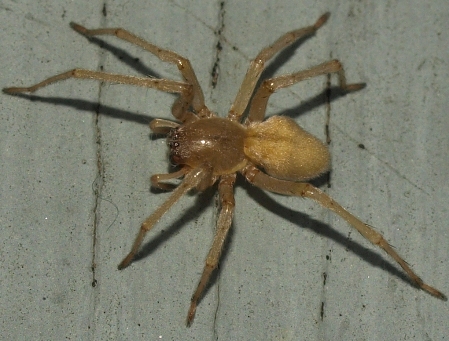
Another sac spider – possibly the same species, but it cannot be
positively identified from this photo. It's either in the Cheiracanthium
or Clubiona genus. My six-year-old daughter actually found this in her
room (and she wasn't too happy). Spidy is now living outside. I wonder what
happened to its left front leg?
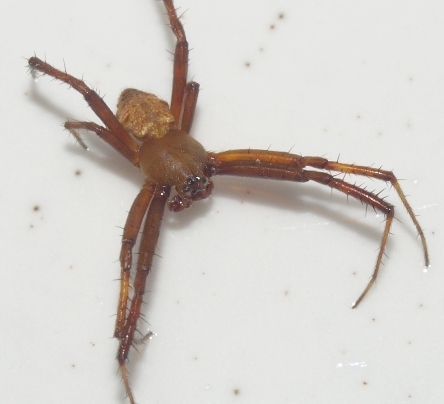
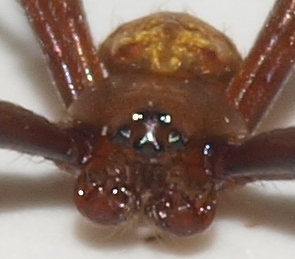
A boy orb weaver of the Gea heptagon species. Dig
those mouthpieces (chelicerae to the initiated)!
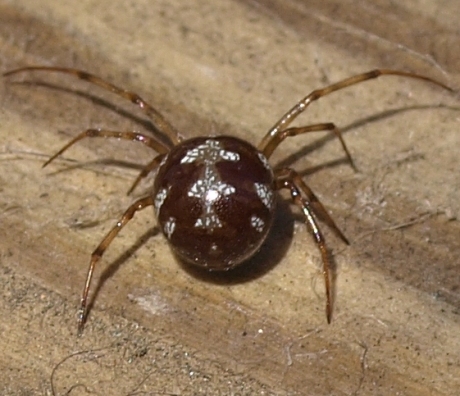
When I was dismantling our patio steps (which were in need of repair), I
found this little gal scurrying on the underside of one of the planks. Which
is about right, since this species, Steatoda triangulosa, is commonly
found in homes or other dark enclosed manmade spaces. It is likely native
to Eurasia, but is now widespread around North America as well. Supposedly
common, but I've only seen the one thus far.
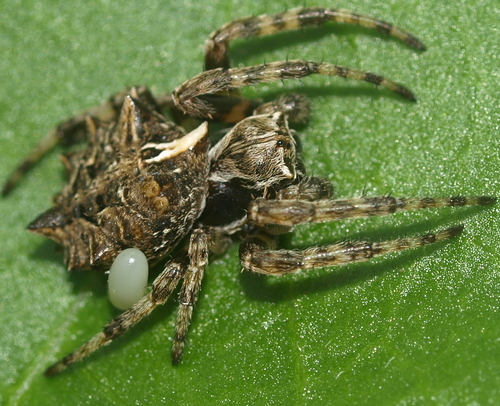
Alas, this star-bellied orb weaver (Acanthepeira stellata)
was already mostly incapacitated by the parasite protruding from its side
(perhaps the larva of an ichneumon wasp) by the time I found it on a leaf one
day in late spring. I don't think I'd encountered this species before – so
I hope I find a healthy one sometime soon.
Texas, June 2018
Hunters, not spinners
I don't know much about spiders, but one distinction between the various
orders seems to be that some spin webs to catch their prey, while others
lurk in hiding or actively hunt. The ones below are webless types.
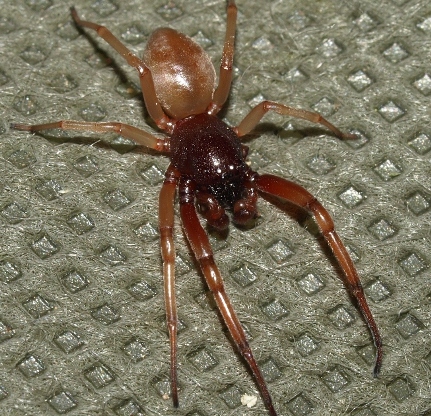
This boldly colored specimen is a male Trachelas
tranquillus, a ground sac spider. He was hanging out on a porch swing cushion
that had made its way onto the back-yard lawn.
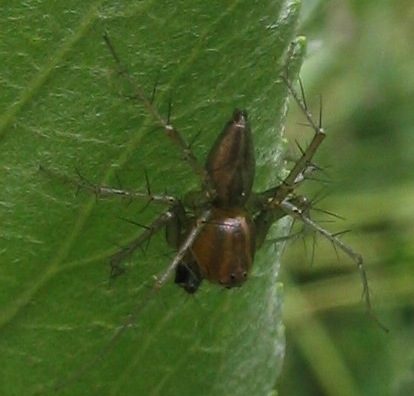
This photo was a nice surprise - when I spotted the spider on a plant, I
knew it was one I hadn't seen before, but I couldn't tell just how
interesting it looked until the photo appeared on my screen. It's a striped
lynx spider (Oxyopes salticus), so named because it pounces
on its prey like a cat.
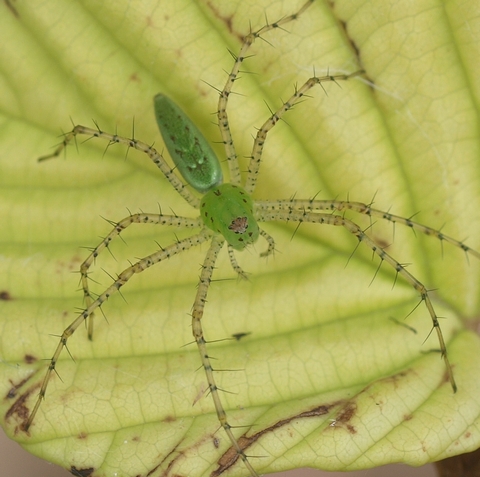
And here's its cousin, the green lynx spider (Peucetia viridans). This
one showed itself to me in our Houston-area garden, claiming an entire leaf of
a winterhazel sapling as its territory. It is reportedly quite a useful
creature, counting many garden pests among its prey. Live long and prosper!
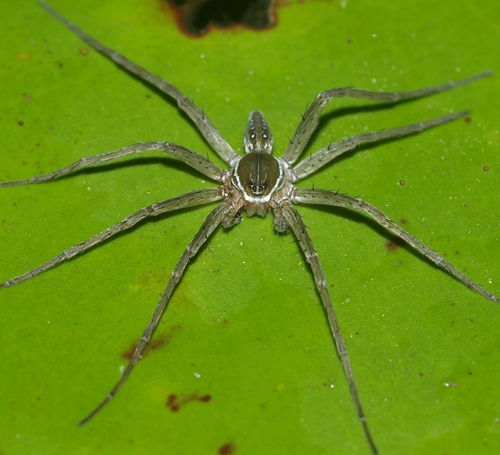
True to form, we found this six-spotted fishing spider
(Dolomedes triton) on a lilypad in our pond. It is a large and
powerful hunder, but did not appear to have helped itself to any of our
goldfish; perhaps it was after one of the many tadpoles swimming around.
The species belongs to the family of nursery web spiders, so named because
they hatch their eggs inside a web tent, with mama standing guard outside.
There are more than six spots on this species' abdomen – the common
name refers to spots on the underside of the spider, which I haven't had the
opportunity to examine. It is found in a wide range of North America.
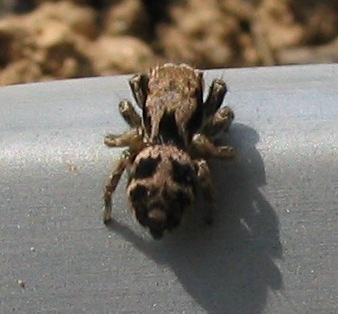
This tiny thing is a jumping spider, possibly in the Habronattus genus.
It was resting on a metal plant tag.
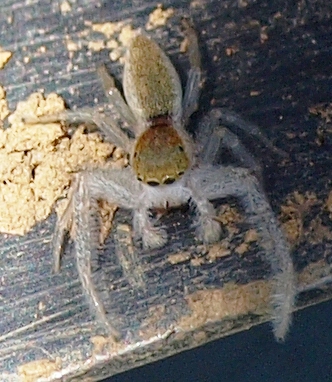
Cool little jumping spider (Hentzia mitrata),
found by Amy (who, to her credit, didn't panic). He wouldn't sit still for a
picture, though, so just a so-so image for now.
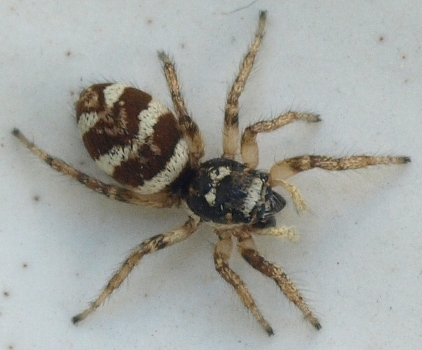
Another jumper, this one squarely in the center of that
class of spiders: it's a zebra jumper, Salticus scenicus. Tiny thing:
the patterning isn't all that clear until you look up close.
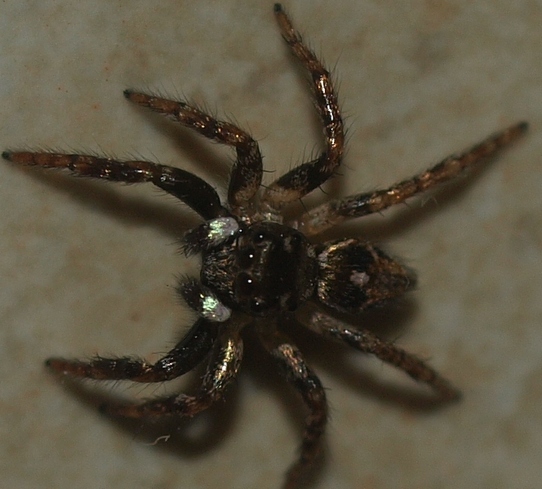
This photo has the distinction of being the very first
arthropod picture I took and posted after moving to Texas. Before even getting
a start on gardening. This little one is a twinflagged jumping spider (Anasaitis
canosa) and it was indeed quite jumpy. Without the benefit of the
photographic enlargement, it wasn't clear what the silvery white parts of the
feelers were. It kept moving them in and out, which made it look almost like it
was blinking white eyes. Its sighting was in plain defiance of the Texas way
of hiring exterminators to rid homes of all manner of unwelcome guests,
spiders prominently among them. We gave in to the trend, following advice from
many, but I'm glad that this spunky jumper survived.
Texas, September 2016
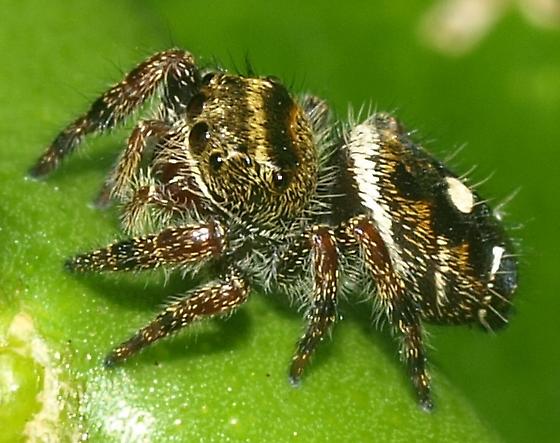
I've seen two of these little jumpers since moving to
Texas. They're ever so cute, and like to gaze up at me with their eight adoring
eyes. I've been told it's a young Phidippus; I think I'll call the next
one I see Philip and see he answers (if she doesn't, I guess I should have
tried Philippa instead).
Texas, November 2016
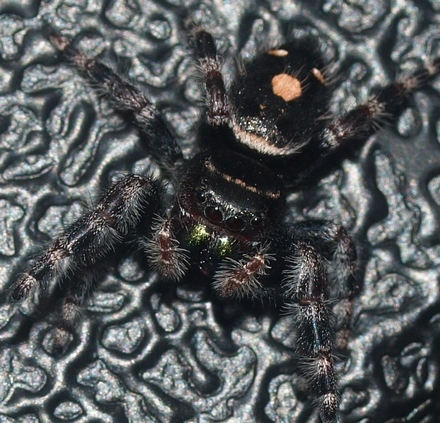
And here's a rather larger specimen of the same species
(now identified as Phidippus audax (the bold jumping spider).
It was scurrying around on top of our compost tumbler one day, which explains
the somewhat poor contrast in the photo (for which I apologize). It does seem
like the color darkens to a true black as these spiders age. I like the
irridescent face on this guy, as well as the quite prominent abdominal spots.
He didn't respond when I called him Philip.
Texas, June 2017
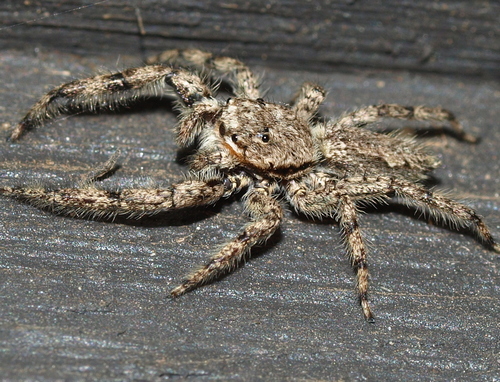
Another jumping spider, mid-sized Platycryptus undatus,
appeared on our fence in October. Non-close-up, it has a tan coloration, a
little lighter than the fence but still fairly well camouflaged. Apparently a
common species, but without common name as far as I've been able to tell.
Texas, October 2018
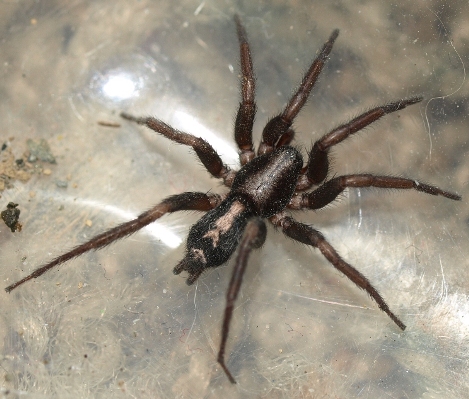
Strictly speaking, this shouldn't be on robsplants.com,
because we found it inside the house - in my boys' bedroom, to be precise, in
the box where my son Ben keeps his fossil collection. This fast-moving creature
is an Eastern parson spider (Herpyllus ecclesiasticus), a ground spider
that's considered mostly harmless. It's named for the pattern in the white
stripe across the abdomen, which supposedly resembles the cravats worn by
clergymen in times past.
Pennsylvania, November 2011
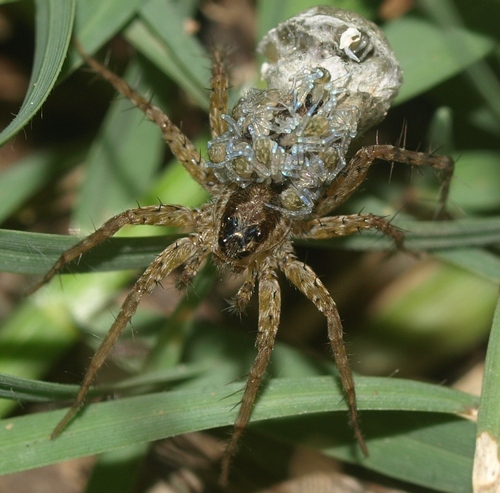
When I spotted this thin-legged wolf spider (Pardosa species)
I thought it was very different from any spider I'd seen before – the
shape of the body, the color combination, I just didn't recognize it. Actually,
I've seen plenty of wolf spiders like this one before; the difference was that
this mama spider was carrying not only an egg sac, but also some of her newly
hatched babies, while others were still emerging from the sac. Despite this
burden, she still got around surprisingly fast. Aren't mothers amazing?
Texas, May 2017
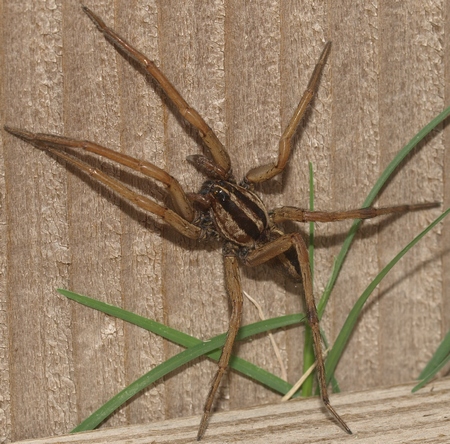
The largest spider, as judged by its legspan, that I've
encountered in Texas thus far, this wolf spider (Rabidosa species) was
sunning itself on our fence in late November. I see its smaller cousins (either
younger versions of the same species, or smaller species) routinely around the
garden, but specimens this size don't come around as much.
Texas, November 2016
Crab spiders
Crab spiders (members of the Thomisidae family) are hunters that
quietly wait for prey to arrive, relying on ambush and camouflage rather than
rapid pursuit to nab their victims. When they come in range, they grab them
with their strong front legs and deliver a venomous bite.
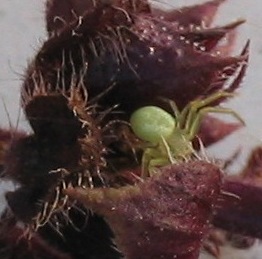
This crab spider was itty bitty (the seedpod is from a basil stalk, to give
a sense of size).
Pennsylvania, October 2004
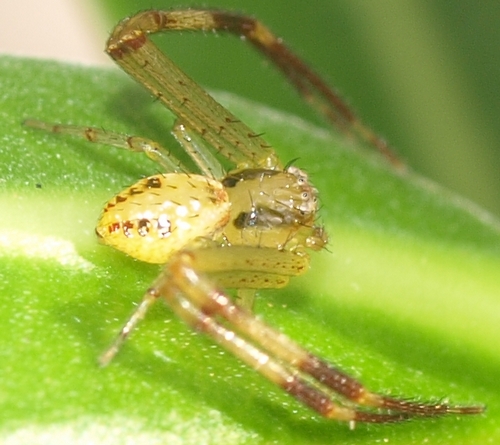
This one, a swift crab spider (Mecaphesa celer) is
somewhat larger, but was still pretty good at hiding between a leaf and a stem
of our small oleander. In this first picture, its two pairs of front legs
(which, as with all crab spiders, are considerably longer than the back pairs)
were folded in a seated position. When I moved the camera to get closer in,
the spider raised its front legs in an attack or capture position. Perhaps it
thought that my Olympus was a tasty morsel of prey.
Texas, June 2017
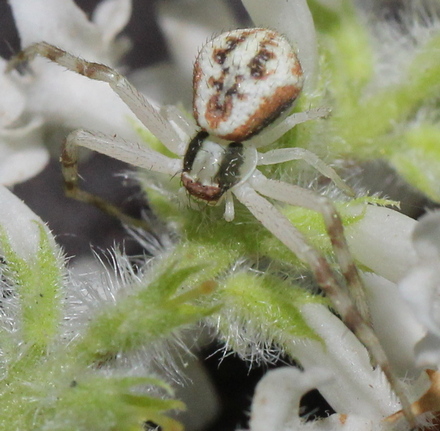
Its cousin, a northern crab spider (Mecaphesa asperata)
was hanging out in some flowers in late fall. It is identified by the spiny
hairs all over its body and legs, and white area around its eyes. It occurs
across a large swath of Central and North America.
Texas, November 2021
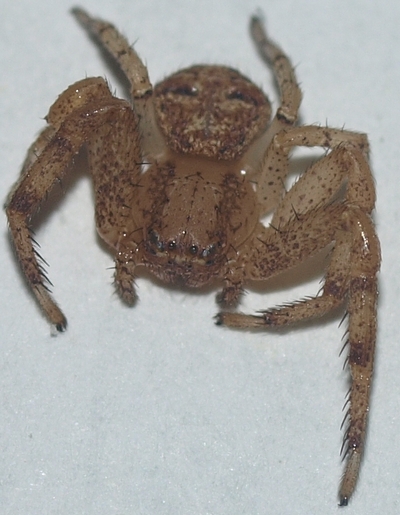
The cutypies at left and below are ground crab spiders
(Xysticus sp.), generally found on or near the ground as their name
suggests. They feed on insects and other spiders.
Texas, October 2017 (left)
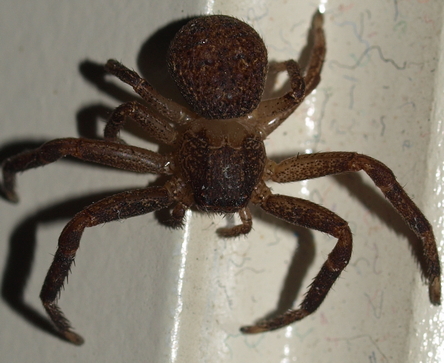
Texas, December 2018
Big daddies
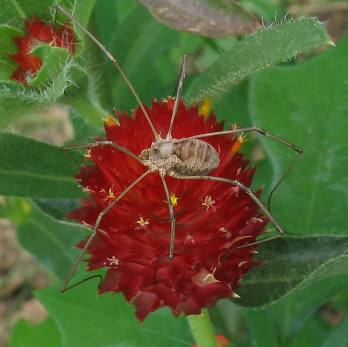
Daddy longlegs, or harvestmen, are not true spiders.
However, they have eight legs and strike fear in the hearts of many female
humans, so I'll include them on this page. The one pictured here, a
Phalangium opilio in the suborder Palpatores, was rather
possessive about the gomphrena flower he had claimed for himself. This species
is common in human-disturbed habitats, and feeds on soft-bodied animals such
as insect larvae, aphids, and slugs.
Pennsylvania, September 2004
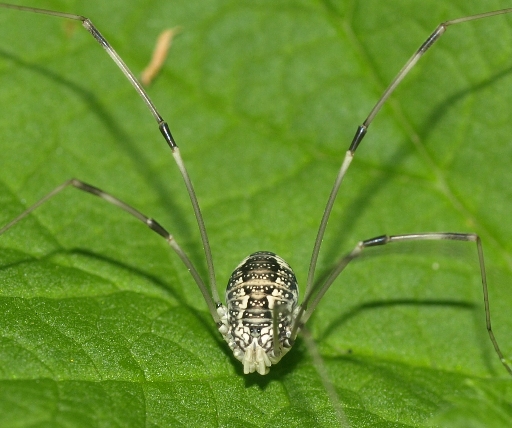
Here's a different one, with twinkly little black eyes
and a darth vader mouth part. There were two of these Leiobunum vittatum
hanging out on a red currant bush one evening in mid June.
Pennsylvania, June 2014
Visitors to this page have left the following comments| Jill | Jul 17, 2007 | Thank you! Although I truly "HATE" spiders and have terrible nightmares about them, this helped me "i think!!!!" to overcome my fear just a tad!!! I transported my plants in my car and this spider was in my car. Freaked out of course, I had a friend put it in a cup with a lid and I searched the web until I found a picture of it here!!! I will put it in my garden, No maybe not! I'm not quite sure I can do that just yet! I'm not sure what i'll do with it! It is quite large I must say... |
| t dicarlo | Sep 24, 2007 | do spiders damage plants ?
I don't know of any examples. Their close relatives, the mites, sometimes do - but you're unlikely to see them without looking really closely. |
| Kimberly Carlisle | Nov 30, 2007 | I have a black and yellow writing spider, in my front garden next to my pond. She has lived there for almost a year. She stays put and eats lots of bugs and looks very pretty for a spider. I used to be so freaked out by spiders. I have learned the value of having them in my garden. Although the first day I saw this spider, I was weeding a sago palm and she jumped up and down on my arm above my glove, I jumped back and almost fell into the pond screeming and freaking out!!! My husband laughed so hard at me, and I had to laugh at myself. So I moved her to a good spot and enjoy watching her everyday. |
| Georgios | Dec 15, 2007 | how dangerous is that Neoscona cruciferae coz i have 1 as a pet ^_^ |
| MALL MALL | Mar 31, 2008 | WOW THESE SPIDERS OR COOL BUT IF I SAW EM ID PROBS CRY |
| adslam | Jul 12, 2008 | may i know what type of spiders can be found in tomato plant?
As far as I know, most spiders aren't particular about the type of plant that supports their webs. Please correct me if I'm wrong. |
| BLM | Sep 09, 2008 | I encountered a big black and yellow spider the other day killing weeds. i screamed and sprayed with bug spray. now researching i guess i shouldnt have since she wasnt poisonous....i'll try and remember that next time i see one. i'll try anyway |
| lisa garbo | Oct 08, 2008 | Yesterday (Tues Oct 7th) I couldn't help notice a brown spider larger than a silver dollar in the center of a 3ft. web stretched from awning to charcoal bag. Cant find a picture of it anywhere but took a video. Its tummy is as large as a medium size black olive. How do I capture & throw her into the yard below? I have herbs on my deck also one tomatoe plant I salvaged from neighbor in Aug. that has born one green tomato, but she,s at least 8 ft from plants. Also I usually have tiny spiders falling from ceilings twice yearly. I noticed draglines while spraying my hair & freaked! Thought my pets had fleas! Ive fogged twice in the past month. I would like to secure my space on the porch without harming this healthy spider. Please answer. Thank you. Lisa
Any manner of transporting the spider without it crawling onto you would be fine. A longish stick would do the trick. |
| Chané George | Oct 27, 2008 | Never kill a spider.It is not YOUR right to decide which Spiders(or any other living creature for that matter) will & will not die. Yes, it's true that there are sicotoxic & nerotoxic spiders out there. some of these spiders are situated in Souther Africa namely: Latrodectus sp. - Black & Brown Button Spider; Loxosceles sp. - Violin Spider; Cheiracanthium sp. - Sac Spider & the Sicarius sp. - Six-Eyed Sand Spider. However I have a SAC spider currently in my Bathroom, between the basin & shower sliding door. She is happy there & I will never kill her just because she can bite me. I breed with a large amount of Arachinids, from the tarantula's to trapdoor spiders. Oh, & just a small FACT for those who out of plain fear & irrationality kills spiders left right & center: More people are killed or have amputations/lost limbs in Car crashes than by spider bites. So next time you see a car... Squash it... |
| Stephanie | Mar 05, 2009 | Personally I think ALL spiders are very scary but I have never killled one in my whole life.........well at least I don't think I have. |
| Venus | May 30, 2009 | I'm TERRIFIED of spiders but I love weeding in the garden; at least I use to (originally from Hawaii, I never encountered thousands of'em under every weed I unearth). And what was theraputic back home is killing me now! I quit smoking two months ago and now I want a cigarette after battling tons of'em yesterday and this morning. I'm really freaked-out! I just want to kill them, all, period! (Sorry spider enthusiast), it's really pathetic on my part, I know but do you have a remedy to rid my garden of spiders!
.
.
|
| Kisha | Sep 13, 2009 | I love spiders. They actually do us and our gardens a favor by eating insects that destroy our gardens and insects that annoy us. I've never killed a spider before, but have spotted a recluse spider in my home on several occasions. I just scooped it up in a plastic cup and put it outdoors. I actually own and handle several species of tarantulas as well as bunnies. |
| David | Oct 15, 2009 |
Every time I see a scary spider in my house I want to call in a napalm strike - or at least pull out my flame-thrower. |
| Linda | Oct 30, 2009 | I have 2 Hentz's orbweaver spider's in my yard that each make a large intricate web about 10 feet above the ground every nite. I caught one of them one night in the early morning rolling his web in first from the bottom then it turned around and rolls the web in from the top rolling in all of his catch from the night. They always have few long strands that anchor their webs from a couple of different directions.
Does anyone have any further info regarding average life span, do they feed on what they caught the night before, or store some, or any other interesting info? |
| Carson Parry | Apr 13, 2010 | Dang. I hate spiders, but you took some cool pictures |
| Sammy | Aug 15, 2010 | Hi, just letting the gardeners know that spiders are great for keeping pests away. If you notice webs on your tomato plants, they are actually positioning themselves for dinner so don't panic ^_^ I do know of some exceptions so before you go around squishing our allies please research on the internet with a description of the spider and what plant the inhabit. |
| Ian | Sep 28, 2010 | "how dangerous is a brown recluse?"-- Not very as the brown recluse is a very shy spider. The venom in its bite may be an issue, but prompt treatment should keep a person in fine shape. The pictures found on the internet with people who have lots of dying flesh (like a whole forearm) around the bite site are the result complications from poor/imprompt medical attention--at that point they've developed gangrene and other infections, and this takes many days to for that to happen.
FYI,
Spiders don't damage plants, some species will roll up a leaf, hold it in place with silk, and use it as shelter, but they don't eat any plants--only insects and other small things. There's one known exception to this however, scientists recently discovered a jumping spider species in Malaysia that eats bits of mango. If you've got spiders in your garden it's a good thing, like Sammy and others have said. They eat a lot of pest insects.
FYI: All male spiders will have large pedipalps (the quasi leg parts near the mouths that aren't chelicerae).
Also, for spiders that weave webs, you can make an educated guess about certain species/families by the shape and cleanliness of the web. Funnel weavers don't remove their finished meals, while many orb weavers will remove their finished prey from the webs. Orb weavers will often recycle their web/reweave them. |
| Hello Hanny | Sep 29, 2010 | I am watching a spider right now that has created a large web on a bush outside of my screen. Thus, I can safely watch him/her through the screen without fearing he/she will jump on me! It must be female as lately I have noticed slightly smaller and much smaller spiders in the web that look like little versions of the bigger one that I have watched for a few months now! EWE. I am pretty sure it is an orchard orbweaving spider. Sorry, but I have a small 2 year old child who loves his back yard. Between the spiders life and my son possibly getting entangled, I choose my child.
I also exterminate my yard for ants too. I don't feel one bit bad ether :) And, I set off "bombs" in my garage for insects every other month too (I live in Florida). At least I know I am as safe as I can be, especially my son or any other children in my home!
I love to get online and look at pictures, but I don't want them in my own backyard.
Spiders won't hurt your son (not unless you have one of the few ones dangerous to humans. It would be just about impossible to eradicate spiders from a yard, so my advice would be to leave these beneficial critters be. |
| Garrett | Jan 30, 2011 | I have a rather large flower garden and it is completely filled with spiders!!! I love them though...they tend to kill many pests including mosquitoes.So i owe the little guys/gals for that.My personal favorites are the writing spiders and the Hentz's Orbweavers. They build webs all around my deck/porch and it's really relaxing watching them re-spin their webs whenever they get damaged or have too many insects in them.And to everyone talking about fogging/bombing their homes for spiders,u should do your research!!! The chemicals/pesticides in those foggers will do loads more harm to you/your families than any little spider ever will. |
| Rich | Apr 28, 2011 | Rob, what guides do you use for spider identification? I have been looking for something good. I understand that the immense number of spider species vary significantly by location, but it would be nice to be able to know the various types and some specific examples, as you have crab/jumping/orb etc. Thanks.
I don't have any good spider guides, so I rely on the expertise at bugguide.net for identification of new ones I find. |
| Lucian K. Ross | May 06, 2011 | Rob,
Very nice pictorial representation of the spider fauna in your garden. However, one statement regarding the potential medical significance (harm to humans) of the Cheiracanthium species C. inclusum and C. mildei (Araneae: Miturgidae) is based upon many largely speculative reports of this species producing dermonecrotic lesions in human bite victims. Several studies on bites by Cheiracanthium species in the United States and Australia failed to provide evidence to support claims of the venom of this species producing dermonecrotic lesions in humans. I, myself, have been bitten dozens of times by sub-adult and adult males and females of both species and, only suffered minor localized redness and swelling at the bite sites, and these minor symptoms appear to be typical of bites produced by Cheiracanthium species. Great photos!
Best Regards,
Luc
Thanks for the additional information, Lucian. |
| Jennifer Bashford | May 16, 2011 | Thank you so much for the information. I live in Malta and for the first time I am growing cherry tomatoe plants on my balcony. The plants are now about 6" tall, look healthy (they have no flowers yet. I have noticed cobwebs and a couple of small spiders on my plants. I went to the plant shop and they offered very expensive insecticide and organic spray. I did not want to use either so looked for guidance on the internet and came across your page. I think I can leave them be.... Your representation was so interesting and educational. Thank you. |
| Len | Sep 23, 2011 | You haven't talked about the latest addition to the widow family. I made a practice of walking around my house at nightfall with a powerfull flash light The black widow is often found in the middle of a web about one foot from the ground and one foot from the structure. I have captured several over the past year. I take them away to a field nearby because I do not like to kill them. over the last few months I noticed there are no more black widows but now I am finding many brown widows. I have researched them and have been capturing them including their eggs and sending them to the University of Riverside where they have continued research about the origin and their migration to the US. |
| bruce | Sep 24, 2011 | i found an extremely large spider i think is a spotted orbweaver,in my fathers tomato plant.there is roughly 15 to 20 feet of spider web on top of his shrubs and this spider was in a web about 2ft wide hiding under a leaf on the plant .its body is 1/2 in in diameter the whole body is 1 1/4 inch long.finding it a new home after a little show and tell with the kids
|
| Tuomas | May 10, 2013 | I love spiders i also wanted to have a tarantula for a pet cause you
can handle them and everything as long as there not poisonous and the venom
is out of them.I also like black widow spiders cause of there very unique
design on them and the colour of them.....:)
|
| M. | Apr 22, 2016 | This is a great page, and I feel bad that I'm commenting to add a small correction... but the common name for the species Neoscona crucifera is actually just the Hentz Orbweaver, rather than Hentz's Orbweaver. The "American Arachnological Society Committee on Common Names of Arachnids" (a mouthful) says that spider common names can't be made using the possessive form of proper names. I'm not sure if a link will work in this comment, so I won't post it, but if you google the committee name, the manual/PDF should pop right up. The latest edition is 2003, but there will likely be a new one out in the next couple years. There are lots of sites using "Hentz's" so I've just been casually dropping a line to them if/when I come across them. (I'm a member of the committee.) Thanks for your time, and this excellent reference on spiders!
Thanks for writing - I've corrected the name. |
| Wanghuck Blon | Sep 01, 2019 | it is nice to see your contribution to the world
really appreciated
hope you will keep up the same spirit |
I welcome comments about my web pages; feel free to use the form below to
leave feedback about this particular page. For the benefit of other visitors
to these pages, I will list any relevant comments you leave, and if
appropriate, I will update my page to correct mis-information.
Note that I discard any comments including
html markups, so please submit your comment as plain text. If you have a
comment about the website as a whole, please leave it in my
guestbook. If you
have a question that needs a personal response, please
e-mail me.
Last modified:
January 04, 2026
Contact me
|