 |
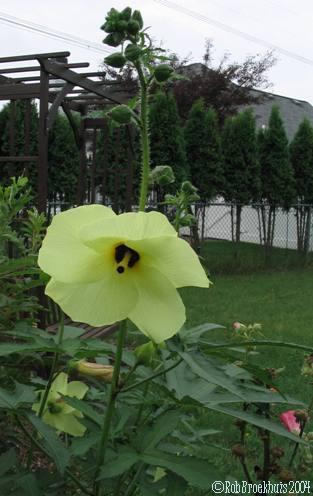
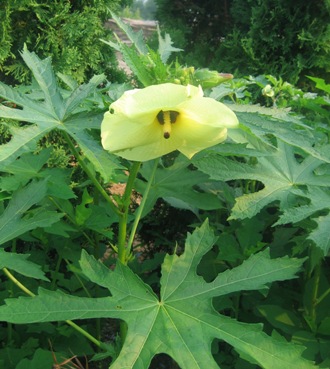
Abelmoschus manihot |
 |
|
|
| Common name |
flowering okra |
| Family |
malvaceae |
| Life cycle |
tender perennial (Z8-11) |
| Flowers |
yellow/black (late summer) |
| Size |
5' |
| Light |
sun |
| Cultural notes |
ordinary garden soil |
From seed  |
Germinate at room temperature (bottom heat helpful). Occasionally self-seeds in our garden. Sometimes requires hard nicking to germinate.
detailed seed-starting info below
|
Striking, large lemon-yellow hibiscus-like flowers, deeply cut foliage. Upright plant habit. We grow it just about every year.
|
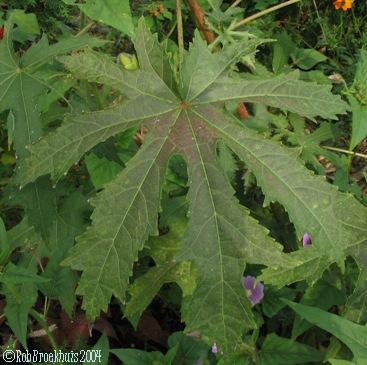
| | I like the subtle fall coloration of the bold leaves, starting around mid-October. |
|
|
We left this plant behind in our Pennsylvania garden (and wish it well); we don't grow it in Houston. About my plant portraits
PlantLinks to other web pages about Abelmoschus manihot
Visitors to this page have left the following comments| A visitor | Oct 15, 2004 | Tall annuals like this are underused in most gardens! |
| anthony (sunta cruz,california) | Mar 20, 2006 | hi again..sorry for the Q&A's... do you have any luck with these Abelmoschus coming back up at all?..ive never grow them before, just planted some last year. just wondering if they send shoots back up, i see you listed it as a annual?
thank you for all the SUPER help! it really does help!! yep
As far as I know, it's an annual. I get occasional self-seeding, but not enough to be reliable - I start new ones every year. |
| Pat Frizzell | Jul 30, 2006 | It's been 20 years since I've had a flowering Okra vine. My husband LOVED it and has often asked me to plant it again. I only have space for a very few seeds (enough to cover a trellis about 4' wide) and I hope you can let me know how to get them. I'm 78 years old (my husband is 81) and I'd like to surprise him next spring. (or can they still be planted?) Thanks, Pat
I do have some seed - which would be best planted next spring. If you're interested, please email me (link at the bottom of this page). |
| Jamil, Bangladesh | Jul 16, 2008 | manihot is an important genetic resource having resistant gene against Yellow vein mosaic virus and therfore could be used for genetic improvement program of OKRA. |
| Glenn Steinberg | Mar 27, 2011 | Abelmoschus manihot is actually a perennial, but it's not hardy in zone 6 (your zone and mine). I think, however, that it's supposed to be hardy in zone 7 or 8 (Dave's Garden says 8b). I used to grow some in pots and overwinter them on my mostly unheated sun porch. I decided that I was tired of caring for the pots and let them out one winter a couple years ago, but I've just gotten seed again. I'm going to try to grow them in a cold frame that I have and see if they overwinter successfully. I'll also put a few in pots and overwinter on the sun porch again. The leaves and flowers are edible, and the seed heards can be eaten like okra.
You're absolutely right. I've updated the page. |
| kp | Jul 06, 2012 | i found this growing in a crack in concrete . zone 7b. may have gotten dew runoff from a nearby eave. was three ft high and covered in flowers. i watched it until now in july and i gathered seeds. guaranteed no one took care of it. super hairy and itchy |
| jane | Apr 30, 2013 | I live in Florida, but just got back from Fiji, where I ate this plant (bele) all the time. I read not to eat the leaves raw, but I did and had not problems. Anyway, I have a few seeds. Can you give me a bit more info on germinating them. How long might it take for germination? I tried a few but had no luck so far and I only have a few left. I would give my right arm for a few cuttings to start. Are you in the US?
If you have viable seed (nice smooth round balls), they should be fairly easy to germinate. Just give them some extra warmth, and germination should occur within a few days. Nicking or filing the seed coat may be helpful if you're having no luck. |
- Seed from '00 garden. Baggy 75F (40+%G, 7-18d)
- Seed from '03 garden. Baggy 75F (75%G, 2-6d)
- Seed from '04 garden. Baggy 75F (50%G, 8-30d). Germination only occurred after successively more severe nicking operations, eventually cutting a gap with a knife
- Seed from '05 garden ('06 seed failed, molded). Sandpapered, baggy 75F (56%G, 10-36d)
- Seed from '07 garden. Sandpapered, baggy 75F (84%G, 5d)
- Seed from '07 garden. Sandpapered, baggy 75F (78%G, 5-9d)
- Seed from '09 garden. Sandpapered, baggy 75F (7%G, 8d). Molded quickly
- Seed from '09 garden. Sandpapered, baggy 75F (20%G, 4-8d). Once again quick mold development, though it didn't seem to prevent germination of viable seeds
- Seed from '09 garden. Baggy 75F (no G, 24d)
- Seed from NARGS '12/'13 exchange. Sandpapered, baggy 75F (100%G, 5-10d)
- Seed for 'Mischief' from HPS/MAG '14/'15 exchange. Baggy 75F (33%G, 7-13d) - sandpapered - 75F (50%G, 2-d)
Seed maintains viability well over several years. Be careful when harvesting seed - both seed borers and moisture (and resulting fungus) can ruin seed.
I welcome comments about my web pages; feel free to use the form below to
leave feedback about this particular page. For the benefit of other visitors
to these pages, I will list any relevant comments you leave, and if
appropriate, I will update my page to correct mis-information. Faced with an
ever-increasing onslaught of spam, I'm forced to discard any comments including
html markups. Please submit your comment as plain text. If you have a
comment about the website as a whole, please leave it in my
guestbook. If you
have a question that needs a personal response, please
e-mail me.
Last modified:
March 29, 2013
Contact me
|