 |
Nicandra physalodes |
 |
| Common name |
shoo-fly plant; apple of Peru |
| Family |
solanaceae |
| Life cycle |
annual |
| Flowers |
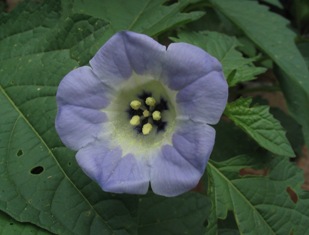
blue (summer) |
| Size |
4-6' |
| Light |
sun-part shade |
| Cultural notes |
ordinary garden soil |
From seed  |
germinate at room temperature; self-seeds
|
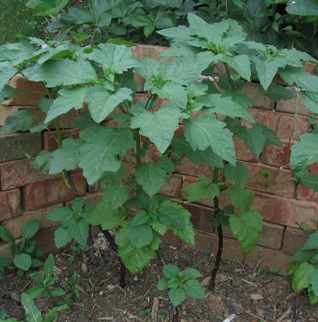
Large, leafy annual, covered in powder-blue flowers in mid-late summer. We grew this once on purpose, and have had it in varying amount from reseeding in the following years. One year only a few smaller plants re-appeared - I guess I weeded them out too well. It's not appeared in recent years. If I ever wish to re-establish them in our garden, the key will be to find the right balance between rampant reseeding and wholesale removal...
|
This plant used to grow in our garden, but it slipped away... About my plant portraits
PlantLinks to other web pages about Nicandra physalodes
Visitors to this page have left the following comments| Rhonda Wright | Apr 26, 2005 | I know you here this all the time, but I love your website. I can spend hours looking at all the unusual plants. Is the height on this actually 4-6"? It doesn't look giant.
This particular one stayed small, having self-seeded in a more shaded area. When properly grown, they get quite large. I'm sure I've seen 5' on mine in years past. |
| Jane | May 14, 2005 | We grew monster sized physalodes last summer, grew to over 5 feet! We have very little sun in a basement garden 200 yds from the sea in East Sussex. |
| Diana | Jul 15, 2005 | Rob,
I found one in my backyard in California and decided to let it grow. It's now about 8 feet tall in a part sunny location! |
| Newton | Jul 29, 2005 | My Shoe Fly Plants are 5' high, have blossomed well and now have lots of fruit. Can I use the fruit?
I don't think so. Although it's not been established that the plants or fruits are poisonous, most sources caution against consuming any part of the plant. For example, this page. |
| Beverly Wallis | Aug 21, 2005 | I have just moved and find I have a shoo-fly plant in a large pot in my yard. my yard. I live in Palmer, Alaska. I need to know how to store it for winter. I understand that it doesn't get as cold as other parts of Alaska here. Could you help me.
Nicandra is an annual, and will die back after it completes its seed cycle, no matter what the temperature. Make sure to collect some seed, and start some new plants in spring. |
| Susanlynne | Dec 04, 2005 | The Shoe Fly Plant is also a host plant to the lovely beautiful sphinx moths, also called hawk moths. Don't be surprised if you find the green or brown sphinx moths munching on the foliage, and please allow them some food. They will eat and then go to ground to make their cocoons in the soil. There are the beautiful hummingbird moths that you sometimes see flying during the daytime!
Susan |
| David Roberts | Sep 03, 2006 | We found a Shoo-fly plant in a small car park of our local N.Wales church, it has grownthrough a layer of bitumen road scapings which were placed on soil and used to make a surface for parking. the scapings were brought from close by, but no evidence of a Shoo-fly plant could be found in that area. |
| Stuart Smith | Jul 14, 2008 | I am the Community Police Officer for Saltburn-by-the-Sea, England and Vice-Chairman of Saltburn In Bloom. The town is entered in Northumbria in Bloom and Britain In Bloom Compititions. I have the Shoe Fly Plant in the Police Station gardens and it always gets positive comments by passers by. The best way of reproduction is to collect the seed in winter and re-seed in the spring indoors. |
| Jean Ford | Sep 12, 2008 | your site is very informative and helpful. I first had a Shoe fly plant given to me by a works colleque. They stayed small where i lived in Rochford Essex. Now I have moved and live in Shoeburyness near southend on sea. Planted my shoefly and to my supprise it is now approximately 4ft high and spreading. |
| Maryanne Starcher.....zone 5 | Sep 30, 2008 | This summer was my first attempt to try Nicandra Physalodes, Black Rod from J.L. Hudson Co. I live in a flood zone area and my garden soil is black carlisle muckland. My garden sat underwater for three days and I lost many hundreds of seeds. I ended up with only three Nicandra Physolodes, Black Rod
along with several other types of plants. The plants grew about six feet high
and about 4 feet wide. What beautiful flowers and seedpods. I just finished
collecting the seedpods for next year to replant and trade.
Plan to try the varigated nicandra physalodes, Splash of Cream, offered by
Fragrant Path and J.L. Hudson for next year. |
| Vera Moore ....zone 5b-6a | Apr 02, 2009 | I most have grown them in the wrong spot last year as mine only made it to about 2'! It was growing in a fairly packed garden too and am sure that made the difference right there. This year I plan on giving it lots of more space and think I'll place it with Polygonum orientalis (Kiss-Me-Over-The-Garden-Gate/KMOTGG). Both have been wintersown but nothing has germinated just yet; keeping fingers crossed :)
Also regarding Susanlynne's comment about the Sphinx/Hawk Moth. You might not care to let them live in the garden if you are also growing peppers/tomatoes. The larvae of these moths are the Tomato and Tobacco Hornworms (2 separate species) and will literally eat and or devastate a plant overnight. There are plenty other pretty hummingbird moth species that are not problem pests :)
|
| Debbie Pedersen | May 16, 2009 | Hi, I have grown a whole pile of these beautiful plants from seed, and have now put them out on the sundeck. They seem to have whitish brown irregular shaped spots on the leaves and some of the lower leaves are either eaten or falling off. I have sprayed them with Genius oil for bugs. They have been getting a few days of afternoon sun. What do you think the problem is? Sounds like I should get them out of my greenhouse with tomatoes and peppers! So let me know what might be wrong.
thanks. |
| Cristine from Holland | Jun 05, 2009 | THE SEEDS ARE VERY POISONOUS! The plant is very easy and in an early stage recognizable by the black hairs on the leaves. |
| Rhea from Wiltshire,England | Jul 02, 2009 | This is our first year of growing them from seed,had to be very careful when we put them outside as the slugs love them!!Grown one in a tub but it's not so big as the ones in full sun in the ground,they are bushy & about 3ft so far!Very pretty & named in memory of one of our dear friends as we didn't know what is was called.The Little John plant aka shoefly plant!Thanks for all the info,very helpful. |
| Little Red Person | Jul 11, 2009 | Please remember that this plant is related to Deadly Nightshade, and not just the seeds but most of the plant is poisonous if injested [eaten!] - would suggest washing hands after handling. However, it really is a pretty plant to have in container pots in the garden. |
| Mel, Wrexham. | Sep 08, 2009 | I found these growing in our North Wales garden and didn't have a clue what they were until today, when a friend identified them for me. I had let them grow as I thought they were pretty, although they always had a poisonous look to them. Definitely keeping some seeds for next year. |
| Catherine DeCourcy | Sep 11, 2009 | Two of my Shoe Fly plants were recently MOVED in the hot month of July here in Minnesota (zone 3). I never thought they had a chance of making it through the transition. Next Tuesday their flowers are on the way to the St. Paul Garden Club Flower Show. I've decided to let them self seed anywhere they want----and I'll move them to the best location. |
| Al Bitterman | Oct 12, 2009 | from Victoria B.C. I transplanted this "weed" type from the boulevard shade to our backyard..it is now 8 feet tall.......I am 6 feet tall.......It to me is beautiful...If you want to see it....I can send one from my digital to your email address..OK??
Yes, when given just the right conditions, they can get quite large! We still get a few popping up here and there in wilder areas of the garden, even though I haven't purposely grown them in a few years. |
| DelGel | Jul 14, 2010 | I was given some seeds by a lady on the Isle of Wight and grew the plant for a few years. However, I recently heard how deadly poisonous it is, which would account for my finding a dead mouse draped over it one year. I no longer grow it! |
| Paul Edwin | Jul 16, 2010 | I have two distinct variants of Nicandra physalodes both of which have regularly seeded themselves in the garden for many years. One has dark blue, almost violet flowers with dark green leaves and purple stems, while the other has pale green stems, light blue flowers, and yellowish green leaves covered with tiny black dots. |
| J. Bond | Aug 01, 2010 | I have one of these growing in amongst my runner beans in Dorset, UK. It is currently approximately 5 feet tall.
Regarding toxicity, it is a member of the Nightshade family, and I found a Belladonna growing next to it which was IMMEDIATELY removed. I would avoid touching it if you have any open wounds, do not ingest and wash hands thoroughly after handling just to be on the safe side.
It is the Shoo- (NOT Shoe-) -fly-plant because it is supposed to repel whitefly. It is a pity it has no effect on blackfly, or else I might keep it. But as it is potentially poisonous and not required, for the sake of my cats it is going. It is also know as the Apple of Peru, Peru being its native country.
You are of course correct regarding the common name - I've updated the page. Thanks! |
| Linda Jones | Aug 08, 2010 | i saw Nicandra growing in a front garden but didn't know what it was but I fell in love with it. After some research however,I found it on your web page.I have tried numerous garden centres and seed companies to no avail,have you any suggestions as to where I can get it? This is a must have for my garden, hopefully.
Nicandra is commonly offered on seed trade lists, for example by members of gardenweb.com. I think that may be your best bet. Note that you may have to search by common name to find listings for this one. |
| ed roebroek | Aug 12, 2010 | for Nicandra try seedrack out of Oregon or Thompson-Morgan in the UK or Canada for commercial seed sales .
I saw it growing quite nicely in the Reader Rock garden in Calgary where it seems to self seed poorly and behave quite nicely as a specimen plant. Those 40 below winters keep it under control . |
| Linda C | Sep 12, 2010 | One of these has grown out of the patio, in the unused hole that was for a whirligig washing line! It is now nearly 3' high but over 5' wide with lots of pretty blue lantern flowers. It seems to grow inches every day and loves the rain.
I have nothing like it in my garden and am so happy to find your website that informed me what it is. I will collect the seeds and replant it in the garden, giving it lots of room that it seems to like.
|
| Tom | Sep 30, 2010 | I bought some seeds from the shop in the garden at Great Dixter.
( http://www.greatdixter.co.uk/ )
BTW it is a wonderful place to visit in the summer! |
| Sylvia | Oct 19, 2010 | Two varieties can be found in the Chiltern Seeds Catalogue |
| Annie Jones | Jan 24, 2011 | One of these plants appeared in our garden last summer, we saved the round large brown seeds/pods. When and how can we get them to germinate for this summer?
These plants grow fast from seed, so no need to start them extra early. You can start them a few weeks before last frost indoors (which will probably give you the largest plants), or directly outdoors after last frost. |
| PAWS | May 04, 2011 | I have grown some of these from seeds given to me by a friend. At present they are in pots in our conservatory which is frost free. Will they tolerate frost? We live in a frost trap and may occasionally get frosts in the first week of June by which time they will be enormous.
I think they can tolerate some frost. If I'm wrong, and you find out the hard way, please report back... |
| Fenella Thompson | Aug 18, 2011 | I live in Swanage Dorset, and this plant appeared growing prolificately in a recently repotted shrub very near my bird table.It reminded me of the south african castor oil plant and also the cape gooseberry. I have been very intrigued watching this plant grow and am grateful to now know all about it. |
| Peter Sharp | Aug 25, 2011 | I found this plant in a garden, saved some seed and grew it the next year,in pots. It's now 5 foot tall and covered in blooms. In Yorkshire England. |
| MarkThomas | Sep 23, 2011 | This is such a helpful page. I didn't know what the plant was, but a descriptive search on Google brought me to your site. I have a load of these growing on an area which until recently was shaded by huge trees. When the trees were removed in April the plants started to grow,along with some Belladonna unfortunately!. The area is going to be built on soon but having read this page I'll keep some of the seed pods for planting in the spring. Many thanks |
| Julie Long | Sep 25, 2011 | This is a briliant site. We were walking in the fields near our home yeaterday and found this plant. It is beautiful and we have taken a few leaves to see if they will root....has anyone had success from rooting the leaves of this plant instead of using seeds. |
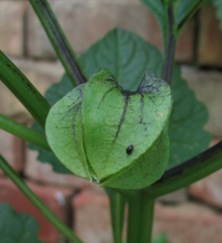
| Jenny Rigby | Sep 25, 2011 | Lots of these plants have sprung up in a field after soil excavated from the back garden was dumped there. Yes, there are lots of bird feeders in the back garden, so assume that the seed is a constituent of wild bird seed mix.. The plants are really pretty, but it wasn't until the lanterns appeared that we realised they were a type of physalis and had something to go on. Thanks for the information. It's a shame that the fruits are poisonous - assume that this applies to livestock too (there will be cattle in the field soon). |
| Jeanie | Nov 22, 2011 | I'm so pleased I found your webpage. I live in Devon close to Exmoor.
I was searching for information about 'Nicandra Physaloides' and how to grow it. I was given a branch of the 'lanterns' at our flower club and have collected quite a lot of seeds from it.
It's really great to find so much information about this plant. Thank you.
I shall certainly bookmark your page.
|
| Ginnie | Apr 25, 2012 | So glad to have found this website and identified this lovely plant. Just one appeared in my garden a couple of years ago and I have kept the seed pods and re-sown each year - love it! |
| Cheshire Cat | Jul 21, 2012 | My mother-in-law gave me the some 'Eric Plant' seeds some 8 years ago, (Eric gave her the seeds but no-one knew what they were). I love it. It suppresses weeds, it looks fantastic, it is a talking point for visitors, my flower arranging friends love it dried. My grand children have fun painting or spray painting the dried branches and seed heads, they look forward to the messy Christmas thing, it's has, when they were were younger, been a learning platform for them to know what grows in the garden; what you can do and what not to do with plants (ie not touch potentially poisenous ones - and, just as important if not more so, to wash their hands if they do - don't frighten them just say it's oooogh that's ugghh!! make a game of it is always preferred to saying NO) I did see on a forum to my plants in tubs to keep the little biting things at bay but I have not been sucessful in confining them. I am sure there must be a rational reason for the name Shoo Fly, if only it could be harnessed. |
| Barry Lewis | Sep 18, 2013 |
I live in west Cornwall,UK, Ifound three of these plants growing in my garden, they are certainly very attractive as us the humming bird hawk moth which apparently feeds on it.. They are very welcome.
I would love to know the life cycle of the moth,where does it live in winter? |
| Barry Lewis | Sep 18, 2013 | I am clearly going to have masses of seed.
Should anybody want some simply e mail me and I will gladly post you some.
Barry lewis144@btinternet.com (all lower case) |
| robert jennings | Oct 08, 2014 | one minute you don't know and the next you do.a friend of mine gave me some seeds.i grew them this year,some in tubs others in the ground.did not have a name for these plants.toook a branch to the local Lincolnshire garden centre.they came back with a definite answer.they sais it was a blue flowered cape gooseberry,looked this up on the internet which said the fruits are edible and tasty.yes I tried them.met a mate who lives not very far from me,who informed me the plant is a shoo fly.in my tubs they are upto 2foot.in the garden I have one that is just over 7foot tall.hope this helps your readers.and no I was not ill after tasting the seeds.possibly very lucky.rob. |
| Sue | Dec 10, 2016 | I have self-sets of this plant coming up on my allotment every year and people always comment on how unusual and pretty they are. They emerge quite late in the spring. Each seed head provides hundreds of seeds and I always save plenty to give away to anyone who's interested. If you see one, just beg a small branch from the owner in the autumn and you'll have loads of seeds for free. |
| wendy wilson | Jun 18, 2018 | I was given some seeds of Physalodes Nicandra from Glastonbury 23 years ago. Every year they grow with their beautiful blue flowers and green and black lanterns. Usually they are about 3ft tall. Last year the self seeded in abundance so that this year I am trying to find many homes for them! I live on the Isle of Man. |
I welcome comments about my web pages; feel free to use the form below to
leave feedback about this particular page. For the benefit of other visitors
to these pages, I will list any relevant comments you leave, and if
appropriate, I will update my page to correct mis-information. Faced with an
ever-increasing onslaught of spam, I'm forced to discard any comments including
html markups. Please submit your comment as plain text. If you have a
comment about the website as a whole, please leave it in my
guestbook. If you
have a question that needs a personal response, please
e-mail me.
Last modified:
August 01, 2010
Contact me
|