 |
Talinum paniculatum |
 |
| Common name |
jewels of Opar |
| Family |
portulacaceae |
| Life cycle |
annual/greenhouse perennial |
| Flowers |
pink (summer) |
| Size |
2' |
| Light |
sun |
| Cultural notes |
ordinary garden soil |
From seed  |
Germinate at room temperature, do not exclude light.
detailed seed-starting info below
|
| Seed ripens | mid-October |
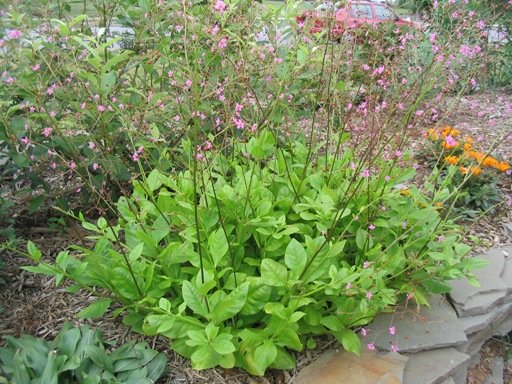
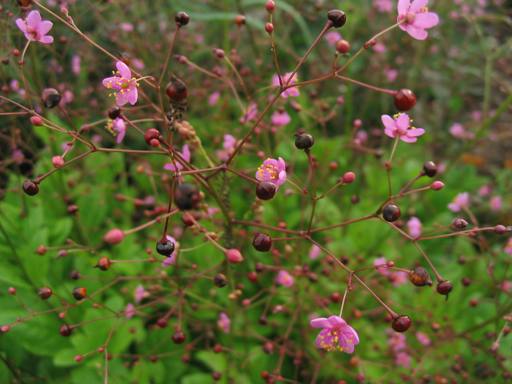
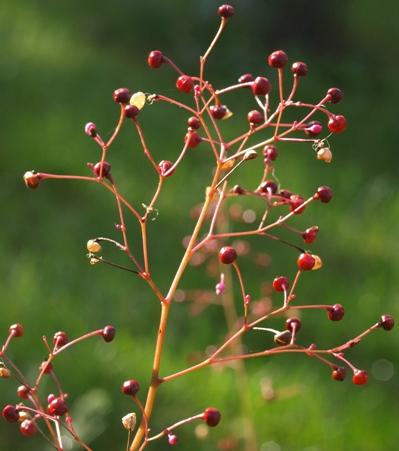
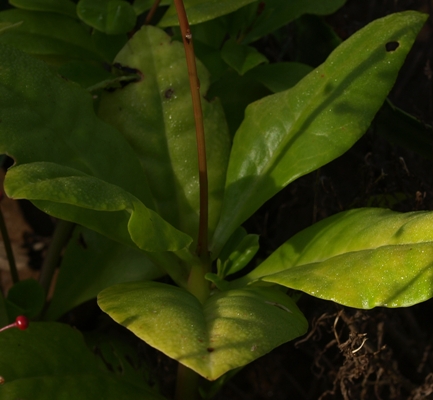
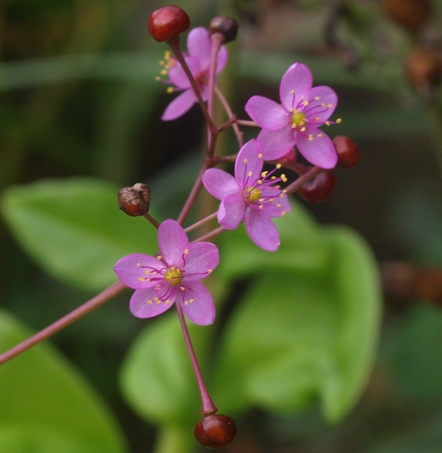
Popular in seed exchanges although not often found in nurseries, the chartreuse foliage of this plant has a soft appearance, giving this plant a delicate look. This is one of the few plants that has done equally well for us in our Pennsylvania and Texas gardens, generously self-seeding in both situations. Usually more seedlings appear than are wanted, but they are easy to remove, so I've not found it to be a nuisance. It is mostly an annual, even in the Houston area, but grows quickly in spring to produce abundant flowers by the middle of May. The individual flowers, on airy stalks, are small, but are nice massed together, especially with the red bead-like buds and fruits. A favorite with bees.
|
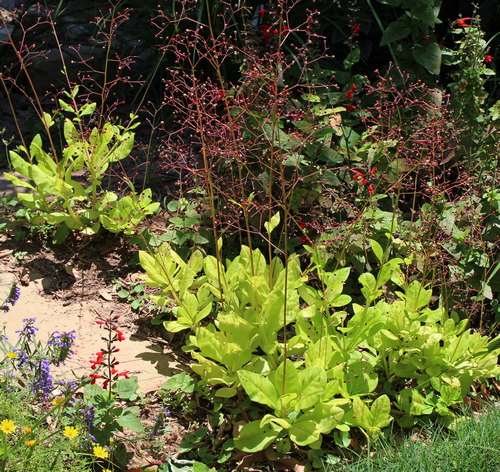
| | Self-sown patch near our Houston rock garden |
|
In our garden, this plant grows in the following areas: back fence border, rock garden zone Seed for this plant is included on my seed trade list About my plant portraits
PlantLinks to other web pages about Talinum paniculatum
Visitors to this page have left the following comments| Jean-Pierre | Nov 22, 2008 | Your web pages are great. I eat the leaves of talinum and I wonder wether the roots could be eaten. Do you have any idea ?
Thanks
JP
I didn't realize any part of the plant was edible. What does it taste like? |
| steph | Feb 08, 2010 | Talinum paniculatum is an excellent spinach substitute that will grow readily in your garden. |
| Joan | Aug 24, 2010 | I bought a hanging basket two years ago which contained a "jewels" plant which I placed on my patio.
This year ( two years later) the plants are growing in between my pavers in the patio. It was a big surprise
since there were no plants at all last year.
|
| Reg | Aug 08, 2011 | This plant showed up in a pot years ago ... from where, I know not. Reseeded itself all over the place and I kinda took it for granted, like a good friend. Then I moved and really missed its delicate airiness. Tried finding it and could not find a source or even a name. Four years later, repotted some other plant into an old pot of dirt and, lo and behold, up jumps one of these. I am now gathering seeds and I am so happy to know what the little jewel is called. Next to weeds, it is the easiest plant I have ever had.
Love your website, by the way. |
| Neil | Aug 22, 2011 | The edibility of this plant reminds me of Purslane (Portulaca oleracea). Does it spread at all?
No spreading. It grows upright from a single rosette. |
| Vincent Dunne | Oct 12, 2011 | Hi,
I came across this plant for the first time in N.Italy where is was being used in a bedding scheme. Just got it idenitified today. Very pretty, sorry I did not bring home some seeds. |
| Maureen Bayly | Nov 11, 2011 | I bought this spectacular little plant 2 months ago, whilst visiting the Garden Festival at Chaumont and have only just had it identified by the RHS. Your website and attached comments are a very welcome additional source of information, thank you. |
| Mary | Mar 28, 2012 | I bought a limon talinum last year at a local nursery. I loved the plant with black mungo grass. When I was cleaning the garden in the fall, I felt the berries were too pretty to toss so I put them in a dry vase. They are still beautiful in April. Some seeds ripened. I kept them and have germinated them so will have more this year. I didn't know what the plant was until I found the tag recently. |
| isabel pangilinan | Apr 19, 2012 | somebody gave us this kind of plant telling us it is a good medicinal herb to help diabetics. i took it home in respect for the person who gave it and just leave it laying in the doorstep.two days after my husband called while in saint lukes hospital's (Philippines) medicinal herbs garden he found exactly the same plant and learned the name. my husband asked me to searched the net for it bringing me to this helpful site of yours. |
| Dorothy | May 10, 2012 | I found this plant at a local nursery in Michigan. I didn't know what it was, but I loved it. Thanks for this website and identifying all of it's qualities. I'm anxious to see how it does in my garden. I bought 3 with lime green leaves and pink flowerettes, 3 with dark green leaves and it looks like the flowerettes will be purple. I only found 1 tag and it called it Verde in the Talinum family. |
| sue | May 15, 2012 | i found my talium at a nursery in illinois and wasnt sure what it was only
knew it was different and they considered it a fragile perenial thanks to your
site i hope to have enough info so it doesnt die it doesnt sound so fragile thank you
|
| Eleanor | Jul 12, 2012 | I've had this plant for forty years and never knew what it was. It is lovely and comes back every year. It develops a tuberous root but also reseeds. A dear old neighbor gave it to me. |
| maureen newzealand | Feb 04, 2013 | I bought talinum this week and had no idea what they were. Thanks for the comments. Are they invasive?
I doubt they are invasive anywhere – certainly not for me. I get a few seedlings sometimes where they grew the previous year, but they never get out of hand. |
| faith | Feb 09, 2013 | Love this plant. Great color and the blooms are so delicate. It has come back several years for me. |
| dave | Feb 27, 2013 | We picked this up at a nursery about 15 years ago. It has re-seeded every year since, though it pops up where it wants and we move them around as needed. It is a charming flowering plant that blooms for us just before dusk. I have even had some appear in house plants that I left outside and it continued well into the winter inside. |
| KIWI | Apr 06, 2013 | Hello Jean-Pierre
Yes, the roots are edible. The Chinese call them Tu Ren Shen that is Ren Shen means Ginseng in English. Tu Ren Shen is Ginseng family but not as good as Ginseng, therefore has the name. The dried root of a five year old plant has medical value. The leaves are vegetables.
Look after your plant for two years, dig out the root in winter time, cook chicken soup with it. The soup will give you a lot energy and keep you awake all night. |
| ESTELA PETTERSON | Apr 22, 2014 | Hola amigos! Esta planta es medicinal, la comprobé, en quemaduras usar las hojas maceradas en cataplasma, igual para picaduras de insectos. En traumatismos reduce la inflamación y alivia el dolor usando también en cataplasmas. Saludos desde Vida Sana Misiones |
| Suzanne | Jun 01, 2014 | Thank you for such a wonderful site! I have found unique details here without reading a ton of info! Question about Talinum...I live in the Chicagoland area and would like this beautiful plant to return every year. Do I need to dig it up and bring it in for the winter, or is it happy in Zone 5?
In any climate that involves freezing, T. paniculatum is grown as an annual. That means the only way it will return next year is from seed. If you're lucky, it will self-seed in your garden (it does some years in ours), but to be sure, collect seed to start some plants on purpose. While bringing the plants indoors might work, I wouldn't recommend it for a plant that can be readily brought to flower from seed. |
| Pat Baker | Jul 22, 2014 | It is beautiful...I have a problem with deer. Do they eat it?
I bet they do – it's nice and succulent. But I don't have deer issues myself, so I can't say for sure. |
| Abdullah Mohd Hashim | Dec 30, 2015 | MasyaAllah.. I have this plat for about7 years. I had few times boiled it leaves and drink it like tea. Informative and wonderful site. Thank you for the info. |
| ludmila kozlova | Feb 20, 2016 | I got it this plant from a friend. i didn't know name until i got to the church market and one lay told me the leaves of this plant is edible and wrought the name.I would like more the medicinal properties of this pretty hardy plant. |
| Michele | May 10, 2016 | How could I get this plant? My son gave me this plant last season but it did not survive and I very much would like to replace it as it is beautiful.
It's an annual, so it's not supposed to survive the winter. If you're lucky, you'll see volunteer seedlings popping up soon. If not, it may be a little difficult to find as a plant, since there aren't many mail order sources for annuals. Seed isn't hard to find, and would be a good choice for next year - maybe even this year, if you act quickly. |
| Sinnathurai Vythilingam | Sep 11, 2017 | Interesting to see how it came into my garden. By looking at a plant I can tell it is not a weed and I separated and grew and later I identfied. My mum has cooked this as a vegetable and I have eaten. |
| Les | Feb 13, 2018 | Hi, in my garden it invaded and there is hardly a spot where this plant is not growing! Could be from home made compost?
Wow, I've never heard of that problem before. Yes, I guess compost could be the culprit, if you've added their seedheads to your pile. They shouldn't be hard to control: they pull up easily, and don't flower and set seed too fast. |
| Sarah | Feb 25, 2019 | If you are in a warmer temperate to tropical climate you have to keep an eye on it because it grows as a perennial in such climates with no frost and can become very invasive, grow and seed rapidly and spread everywhere, even so I am keeping it now I know it's uses and it will grow where a lot of other flowering plants won't in sun and shade. The bees and pollinators love it. I am in south eastern Australia with mild winters it does not die back here in winter. Over 10 years on 2 acres there is no area it has not spread to. If I want it out of an area I have to dig it out because our soil is solid clay and the roots grow very big in it and will not just pull out. I am trying to include it into thickly planted beds where it won't have the room to take over. I used to think it was a weed but my idea of weeds has changed. |
| bhanu | Apr 29, 2020 | I have no idea where it came from but has been growing and surviving on its own in an old flower pot since the last couple of years. I have a small balcony where I have a few pots for leafy veggies and some flowering plants so, had to cut of big stems of this plant every once in a while. And I never knew that this is an edible plant until today! Thanks. |
| Wendy | Apr 24, 2022 | This plant popped up in my brothers backyard about 7 or 8 years ago. He has lived in this house for 35 years. I moved in with him 10 years ago. I asked him if he had ever seen it before and he said no. I did a little checking online and found out what it was and that it is edible. It keeps coming back year after year. |
| Jax | Jan 08, 2023 | This plant grew by itself in my back yard what a bonus!! |
- Seed from '02 AHS exchange. Gelcup 70F under light (good germination, 2-3d)
- Seed from '02 garden. Baggy 70F with light (80%G, 10-13d)
- Same seed as above. Baggy 70F with light (80%G, 9-11d)
- Seed from '04 garden. Baggy 70F with light (95%G, 10-13d)
- Seed from '07 garden. Baggy 70F with light (100%G, 9-14d)
- Seed from '07 garden. Baggy 70F with light (100%G, 8-13d)
- Seed from '10 garden. Baggy 70F with light (28%G, 6-9d)
- Seed from '11 garden. Baggy 70F with light (73%G, 10-12d)
- Seed from '11 garden. Baggy 70F with light (55+%G, 9-12d)
- Seed from '14 garden. Baggy 70F with light (77%G, 12-15d)
Sprouted seeds deteriorate quickly in baggy - get potted up fast.
I welcome comments about my web pages; feel free to use the form below to
leave feedback about this particular page. For the benefit of other visitors
to these pages, I will list any relevant comments you leave, and if
appropriate, I will update my page to correct mis-information. Faced with an
ever-increasing onslaught of spam, I'm forced to discard any comments including
html markups. Please submit your comment as plain text. If you have a
comment about the website as a whole, please leave it in my
guestbook. If you
have a question that needs a personal response, please
e-mail me.
Last modified:
May 16, 2020
Contact me
|