 |
Plant sale tips |
 |
So you want to have a plant sale
Some of you may be familiar with Tony Avent's So you want to start
a nursery, a practical yet entertaining book on what it takes to jump into
the business of selling plants. While I've read the book, I doubt I'll ever
take that big of a leap. But I do sell plants, at a rather less than
breadwinning scale: at my annual spring plant sale,
soon into its tenth edition.
Amateur plant sales are something of a time-honored tradition among the
gardening crowd, and they come in many flavors. Through the years, I've
received plenty of requests for information and tips from fellow amateur
salespeople (women actually - my gender is in the minority here). Enough
that I figure putting it into web page form might be a good idea. So here
goes.
The basics
Why sell plants?
Good question! Since you most likely won't get rich from one-off plant
sales, there must be other reasons. Many plant sales are held to benefit a
worthy cause, often a community organization. Besides generating money for
the organization, a sale may also contribute to the cause by raising
awareness and good will. My cause (finding an excuse and the means to buy
more plants) isn't quite so lofty. But I like to think that by providing a
source of plants, many of them unusual, I'm doing my fellow local gardeners
a service. And I've met many garden enthusiasts through my sale with whom
my path might otherwise never have crossed.
A very practical reason to sell plants is that you have more of them than
you know what to do with. Even though the compost pile is ideally suited to handle
such inconveniences, gardeners tend to be bleeding-heart liberals who
can't bear to inflict the death penalty on deserving (if somewhat free-growing)
plants.
When to sell
Ha! When can you find the time? Preparing for a plant sale is amazingly
time-consuming, so consider your own time constraints first. Family
vacations, business trips, and other events have a knack for getting in the
way. The sweet spot for plant sales, at least in this area, is probably
May-June. Much earlier, and too many plants haven't gotten their act
together yet; much later, and the task of keeping hundreds of potted-up
plants alive through hot weather will become daunting indeed. Besides, May
and June are when most home gardeners are on the lookout for additions to
their landscape.
My sale dates have ranged from April 22nd to May 12th. By late April,
most perennials are up, but very few are in bloom yet. Although I've managed
to sell a few pots of plants that have barely broken ground (butterfly weed,
balloonflowers, joe pye weed), most customers don't have quite so much faith
in me, and prefer to see a thriving plant. Needless to say, it's very hard
to sell hardy hibiscus, indigo, or bush clover at this time - or even in early
May.
Wait just a week or two, till the first week in May, and quite a few more
plants are in flower: cowslips, sweet woodruff, bugleweed are just a few that
come to mind. If the weather has been warm, there may even be some columbine
blooms.
As for time of day - gardeners are early risers. My sales start at 8am, and
customers start arriving at 7:45. By 11am, the tables are looking rather empty.
Although the sale officially goes till 3pm, it's rare for anyone to show up
after 1pm (they have to find me out in the back yard if they do!).
Where to sell
Assuming the sale is at your own home, you may not have many options for
staging your sale. The driveway and front yard are certainly the most visible
from the road, to attract would-be customers who just happen to drive by. But
an exposed outdoor location puts you at the whim of the weather - not just
rain (many gardeners are hardy folk, and will brave some wet to get their
plant fixes), but also wind, which can wreak havoc on your top-heavy plants,
signs, and labels.
Another consideration is security: if you're selling lots of plants, you
will not be able to stage them all on the morning of the sale (I take the
day before the sale off from work, to get the job done). Depending on your
neighborhood, having all of the fruits of your hard labor sitting outside
and accessible through the night may not feel like a good idea.
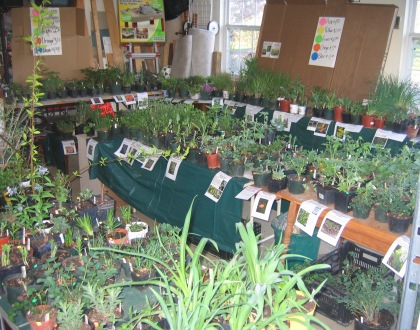
For these two reasons, I have always staged my sale in our family garage.
That involves clearing the amazing amount of junk that collects through the
year (vehicles are never observed in our garage), to create a wide open space.
Over time, I've gathered up a good number of tables and benches on which to
stage the plants - as my plant count has grown, the aisles between the tables
have gotten narrower and narrower - but I don't think I'll ever get more than
four rows of tables into the two-car garage, so there's a natural limit. Only
the biggest plants (typically, larger trees and shrubs) are displayed outside.
Although I've generally been lucky with the weather, the one year that it
rained didn't really hurt the sale at all. Be sure to provide bright lighting,
especially important if the day is gloomy. I keep a couple of 120W light bulbs
on hand, to replace the wimpier bulbs that normally light up our garage - and
I install an additional shop light in the part of the garage where daylight
penetrates least.
What to sell
Know your customers! Now that my sale has gained some notoriety through
years of inter-gardener gossip, it draws a different crowd than it did in the
early days, when few of the plants I sold left the neighborhood. With a larger
number of serious gardeners (and I use that word lightly) finding their
way over, I've been able to expand my plant pallette beyond the tried and
true - which I find quite gratifying.
But make no mistake - the tried and true are great plants, and will always
sell - especially if they happen to be in bloom during the sale! Given the time
of year, I'll always sell plenty of sweet woodruff, creeping phlox, cowslips,
hosta (which always look good), and as many hellebores as I can lay my hands
on. Other colorful and popular stand-bys, even if they aren't in bloom at the
time, do well as well.
For some reason, I've never had much luck selling woody plants. Sure, the
four-year-old redbud in glorious bloom sold swiftly (I had to suppress a bit of
a brawl over that one), but many other deserving shrubs and small trees don't
get much attention. Ornamental grasses, also, aren't the best sellers.
Especially warm-season grasses don't look like much yet by mid-spring. Still,
I offer some woodies and grasses for sale every year, and sell perhaps half of
them.
In the early years of my plant sale, many of my offerings were first-year
perennials, grown from seed in the winter months. Although they attain a
fair size by May, they don't have the bulk and robustness of a second-year
plant. I found they sold poorly, and have since moved to overwintering most
of my perennial seedlings, digging them up for sale in their second year.
Only a few types of perennials, those that grow fast enough to have a full look
and will flower in their first year, are still featured at times on my sale
tables.
How about annuals? Besides a few one-off selections, I don't sell them. I
find that the effort to grow an annual plant is the same as growing a
perennial - but you buy annuals by the sixpack or tray at Walmart, it's hard
to compete with that.
The details (remember, that's where the devil is)
Preparing for the sale
In the past seven years, my sale has gotten bigger and bigger - I would
never been able to keep up if I hadn't gotten ever more efficient in my methods
for preparing plants for sale. I'll tell you what works for me - you may find
that it's different for you (feel free to leave a comment below, so others can
learn from your experience, too).
I guess you could say that my preparations for the sale start during my
seed-starting operation in winter. But to me, that doesn't really count -
most of my seedlings will go into our own garden, the extras are just a
bonus. So for me, the plant sale season starts in earnest in early April,
when I start collecting plants out of the garden. Not many plants are up by
then, but it's good to start early, since there's so much work ahead. Plants
that can be potted up at this time include succulents such as sedums, many
semi-evergreen perennials, and the early-rising perennial crowd. I've learned
to segregate the late-rising plants from others in my nursery beds, so there's
less risk of damaging them when digging up their early-unfurling neighbors.
The thing with early spring is - not all garden supplies are easy to come by
yet. Stores may not stock big bags of potting soil until later in spring, for
example. So a little planning, at the end of the previous gardening season,
comes in handy. I make sure to have a compressed bale of peat moss and a good
heap of county compost lined up by autumn, ready for service as soon as the
season starts. Similarly, I collect pots all summer so I have a full selection
come springtime. Nothing slows the process of potting up more than a lack of
soil mix or not having the right size pots.
Potting 'm up
For a loose, water-retentive potting soil, I mix about one part peat moss
to three parts compost, usually into my trusty wheelbarrow, which I cart around
the garden with a stash of pots of various sizes - ready to pot any plant
that looks like a candidate for the sale.
I collect the plants from all around the garden. Most of them come right
out of the nursery area of our orchard zone,
but many others are last year's stray seedlings that pop up in our lovingly
(un)tended perennial borders. And then there are the plants that keep on
giving, growing enough for several nice-sized divisions every year:
these include Siberian irises, some daylilies, perennial coreopsis and
helianthus species, and hostas.
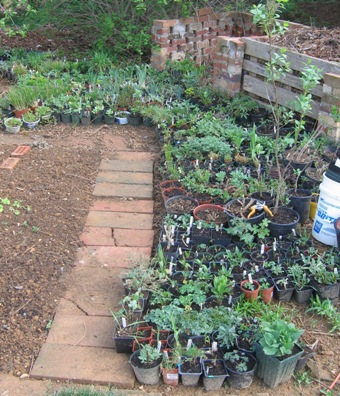
Be aware that you'll need a place to stash all these plants as you're
potting them up. I used to designate a corner of the yard near the garage
for this purpose, but changed a few years ago to a section at the back of
the yard near our compost piles. While it means more work carting them all
across the whole yard the day before the sale, I don't wind up killing a
good stretch of lawn (or having to move the pots around every few days to
avoid premature grass death). When I can no longer reach the compost piles,
and have filled all adjacent areas and paths with potted plants, I know the
sale date must be near!
Advertising and marketing
There are many ways to announce your plant sale to your fellow gardeners –
I've used most of them through the years! Low-tech, and still quite effective,
are hand-written poster signs posted at strategic locations throughout our
extended neighborhood. Don't underestimate the amount of time it takes to
make these; you'll have to buy posterboard about four times larger than what
seems about right in the store, if you want passing cars to have a shot at
reading your announcement. I post them several days before the sale (and of
course make sure to remove them promptly after the event).
Another approach that works well for me is advertising through the bulletin
boards and monthly classifieds pages at my work; similar methods (which I
haven't used) would be posting on bulletin boards at grocery stores, the post
office, etc.
A step up the technology ladder is a classified ad in the newspaper. I did
this for several years. The ads were a bit pricey, but probably helped me
establish a customer base in the early years. Nowadays, I don't bother: enough
people know about my sale through other channels.
And of course there is this website! When first I established the site
four years ago, its intent was to serve as an announcement and advertising
platform for my sale (hence the name). It soon grew to be much more of an
informational and personal website, in which the few sale-related pages are
almost an afterthought - but it is still a useful stage to alert Googling
passers-by about the sale, and inform repeat customers about the particulars
of this year's event. Every year, many come armed with print-outs of my plants-for-sale list, with their wants checked
off.
The website also helps to keep adding to my email mailing list; through
the year, many people request to be added to the list. I send out a reminder
email about three weeks before the sale, and can always be assured that I'll
see a good number of familiar faces on sale day. Even though we see each other
just once a year, the mailing list helps to keep the acquaintance going. This
would work even without a website - keeping a guest list, or handing out
business cards with email address, could serve the same purpose. I've tried,'
but find myself too busy on the day of the sale to follow through with my good
intentions.
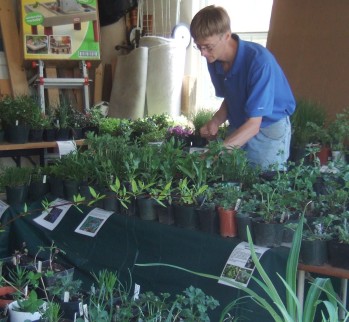
All of the above was about advertising the sale – but you must also
market the plants! If you want to make sure your favorite plant is not sold,
just neglect to put a label or description with it: nobody will touch the plant.
I've learned, and relearned, and continue to learn my lesson: don't offer
plants for sale without a sign that describes the plant and its cultural needs.
Ideally, the sign should have a nice picture - especially for plants that are
far removed from blooming on the sale date. Making photo signs takes time
(especially if you don't have your own photos, and must go hunting for suitable
pictures on the web), so I can't hope to have them for all offerings. I make
some new ones every year, so that by now I have a nice collection of them.
But even if you don't have a photo sign, make sure to have a text sign - even
an index-card, hand-written with a sharpie marker, stating size, sun or shade,
flower color, and any other noteworthy feature goes a long way. I never have all
of the signs made by the time the sale opens, so I use stray moments of low
activity through the morning to create missing ones.
Staging the plants
If you have several tables, it makes sense to group plants according to
their cultural needs. Many customers inquire about plants for sun or shade,
and I'm glad to be able to point at a couple of tables, rather than hunt them
down from individual tables. You'll learn which parts of your sale area are
popular, and which tend to get overlooked. This will be consistent from year to
year, so you may as well take advantage of it by placing your plants accordingly.
Also, during the sale I try to move plants to popular spots after the original
tenants of those spots are sold.
Pricing your babies
Ah, now that's a tricky question! If the proceeds of your sale go to a good
cause, you can apply about the same pricing as local nurseries - part of what
you're selling is good will. But in the absence of other motives, it sure
doesn't hurt if your customers know they'll find bargains when they visit your
sale. After all the potting up and preparing, I'd just as soon sell most of the
plants and save myself the effort of planting lots of leftovers back in our
garden. So I price to sell!
Are my plants guaranteed to be the cheapest deal around? Unlikely -
mass merchandisers sell some of their common stock pretty darn cheaply, perhaps
as low as $2 for a small perennial. But
they don't carry the more interesting species, which you'll pay upwards of $6
for at a bona fide nursery. So I split the difference, and sell perennials at
prices anywhere from $1.50 to $5 - most of them, around $2.50 to $3. I could
probably price a little higher without losing much business, but that's OK. If
I were looking for a more profitable way to spend all the hours I devote to
the plant sale, I'd probably be better off working in Walmart's garden
department!
When you've got hundreds of plants to price, you don't want to write the
dollar price of each individually. Use a color-code system to indicate prices.
Every year, I make sure to have a good stash of adhesive color-dots, in at least
six colors (this usually involves buying two different packages, with different
color selections. Make a few color-price keys to post around the sale area,
and all that's left to do is stick a dot on each pot. Don't be surprised if it
still takes hours to do that - nothing ever goes as fast as you think it should.
Have a great sale!
Even for me, as I'm writing this in November, with the next sale still far
away, the event and all its preparation seems daunting. But there's a lot of
satisfaction in sharing my plants with fellow gardeners, and making some
money to feed my own plant addiction. There will come a day when I'll reclaim
my spring, to have more time to enjoy the garden in all its early glory - but
I think I still have some sales ahead of me. If you're planning one of your
own, I hope you'll find my tips on planning and preparing for your sale
helpful. As for the sale day itself: it will fly! In the flurry of activity,
you may not remember which plants you sold, and to whom - but you can be sure
that many of your home-grown plants will soon shine in gardens all around.
And that ain't bad!
Visitors to this page have left the following comments| Wife | Nov 12, 2007 | he makes it seem like he takes care off it all all by himself! :) "Behind every good man is an even better wife!" |
| Clayton Wiebe | Nov 12, 2007 | Well I planted/transplanted about 80-90 trees this fall since I could not get around to doing some kind of sale. I am hoping to find a few real good Blue Honeysuckles in my seedling nursery and begin propagating them up as a major product. Since we are in the country it would be a farm gate type of operation. I also plan to add Columbines and Poppies as I gather enough to make a sale.
Really good advice here Rob. Clayton's blog |
| Kathryn Garrett | Apr 15, 2008 | I stumbled upon your site and was thrilled. I live in NY and I have sold plants from my house (this will be year 4) and have looked for tips on how other people do it for years. Thanks for taking the time to build this site! |
| Emily- Lincoln, NE | May 08, 2009 | Wow! What a nice website and how generous of you to share you knowledge. I also have a spring plant sale (on a much smaller level) to feed my plant habit. Thanks for sharing! Take care, Emily |
| Mary in Colgate, WI | May 10, 2009 | Thank you so much for all the great advice. I just had a nice little sale which brough me $240 in one day! I was delighted and it got me into the garden early so everything looks cleaned up and ready to grow earlier. You give some great tips here like making signs with pictures. I noticed lots of people referring to these. Also separating the sun and shade plants was a lot easier when sending people to a table. Good luck with your sale this year!
Mary |
| Susan in Minnesota | May 18, 2009 | Thanks for your great website! I'm planning my first sale combined with a garage sale with a couple of neighbor friends. Mostly Echinacea, Rudbeckia, raspberries, herbs and my extras from seed starting :) I hope they sell. Thank you for your great tips! |
| rasham | Jun 09, 2009 | you make it seem so easy to grow and sell. look forward to more tips for a sustainable business of selling plants all thru the year
I don't think that will ever be my mode of operation, so you'll have to seek advice on a full-scale business elsewhere. Tony Avent's book would be a good starting point. |
| Ginny in Ark | Aug 09, 2009 | Thank you for info on selling plants. I'm planning a sale of my plants
next month and this was extremely helpful. |
| Gloria in Oregon | Jan 01, 2010 | I love all that you've documented on your plants and sales. I would highly encourage you to check out freeplants.com if you haven't already. Mike McGroarty teaches us how to propagate and there are people from all over the US. Four years ago I had 5 Rhodies and thought that was landscaping. Now I have 2 greenhouses, 6 hoophouses and a business from our home. Again, thanks and do check out freeplants.com (I don't get paid for telling you about Mike)
Thanks for writing Gloria. I'll check out that website. |
| Deirdre, Sydney, Australia | Jan 01, 2010 | Rob, I love your site - I found it a few years ago and it inspired me to develop my own site devoted to gardening in our region last year. Thanks for all the information about selling plants, which I hope to do some time this year. You have given some great tips! |
| Janie Pauley | Mar 11, 2010 | I have a yard-full of Lariope (very healthy plants) and would like to sell about half of this to someone - a nursery, or individuals. I don't have the
pots, etc. to put them in, but would welcome one big buyer. How is best way to get rid of some of this? Thank you.
Hmm, that's a rather different sales goal than mine. I aim for sheer variety, always something new and interesting, to draw fellow gardeners to my sale. For selling a large quantity of a single plant, I'd say local nurseries would be worth a try. Maybe about a month before they bloom :-) |
| Tina | May 09, 2010 | I've so enjoyed stopping in to read your site and useful information. I will be sure to start my seeds the way you do next year. I do a mixture of wintersowing, sowing indoors underlights but have never tried the wet filter/baggie method. Maybe an added step but no more than planting seeds and for them to never germinate and start all over again.
Also thanks for the info on selling and how you go about planting, organizing and the set up. I grow and sell around 5600 veggie plants end of May- mid June (this will be my 2nd yr.)...but my all time LOVE is FLOWERS and would like to start selling some of the those also next year. I have found your information quite useful and interesting. THANKS!!
|
| dane | Mar 03, 2011 | I am thinking about having a sale this year at home. Along with my home grown perennials, the majority of the plants would probably be from a wholesaler I know. Is it legal to have a sale like this at home or did you have to make it legal?
I have a Pennsylvania nursery license, which makes me legal as far as the state is concerned. Any other considerations would be at the local level, which would vary by municipality. |
| Ana | Mar 17, 2011 | Hi,
I would like to invite you to post at http://www.gardennut.com .
You can list your plants for free there. Your listings are searchable by distance from you. It is like an online farmers market.
|
| Natalie | Mar 28, 2011 | Hello, Thank you for the great advice on your site. I am organising a charity plant sale for mid to late may and need a bit of help on staging. What do you suggest the plants should sit on? Greengrocer grass is an idea that springs to mind, but it is a bit expensive, can you recommend anything as a cheaper alternative?
I don't think it matters too much what the plants are sitting on - if they look good, they'll sell themselves. I have them either directly on beat-up tables or on vinyl tablecloth. More important are signs with some information about the plants for sale. |
| Alison Gordon | Jun 06, 2011 | I've been running plant sales (not entirely on my own) for charity for over 20 years, and wouldn't add anything to your advice - I agree with everything. We use a colour coded system for pricing, but we use wooden lollipop sticks with the ends dipped in different coloured paint. These are recyclable (I've been using the same ones for years); easier to put in the pots; and the person on the checkout table can quickly do the sums for what is being sold, by pulling them out of the pots. I tend to start prepeaing for next year's sale the week after the current year by taking cuttings! But we can sell shrubs here in Scotland. |
| Sue Baltes | Aug 07, 2011 | Great ideas,thanks for creating this web site and sharing your ideas. One I really liked was the pricing with color adhesive dots. |
| Diane Reinitz | Mar 17, 2012 | Any thoughts on how well evergreens sell. Thanks
Based on my particular situation, I'd be inclined to believe they would not be the best-selling plant type, especially if they are small. Flowers rule the sale... |
| Alison | Apr 12, 2012 | Wonderful advice. I have had 2 plant sales so far. This year I will use your tips and will most likely be more successful. Thanks so much! |
| Dolly from Southern Tier of N.Y. | May 07, 2012 | I too could never bare to throw out a 'baby' plant. This will be the 4th spring that I am selling perennials from my garden. I which I had seen your web site years ago. I could have avoided a lot of trial and error. Thank you so much for sharing your information and experience. I will be checking your site often for new ideas and tips. |
| Willie from South Africa | May 18, 2012 | I really love plants and I want to try a plant sale in my neighborhood. I think this will be a first for my country hope it works.
Good luck! |
| Lisa from Ontario Canada | Aug 18, 2012 | I stumbled upon your website while researching the top perennials for plant sales. I've been doing plant sales for 4 years. My first sale was on the roof of our tent trailer (folded down of course!) with 180 plants. I've progressed to about 700 potted plants, and it's so funny that my sale looks almost exactly like yours! I have the same signs in front of each row of plants that you do too. I can send you some pics if you're interested. Thanks for all the wonderful advice, especially concerning the compost/peat potting mix. I've been using a bagged black dirt/peat mix, but it's not the greatest for seedlings. I'm still looking for new plants to plant for future sales, so I'll look at your "plants" tab. Keep up the great work! |
| Alison Jones | Jun 14, 2013 | I have had now 4 plants sales and this website article really helped me get started. This was my first plant sale year where I really tried to work smart not work hard. The tables were ready with plants a day before the sale instead of scrambling and doing a late night plant arrangement. I woke up refreshed and ready. You are right, people come early! I even bumped up my sale time to 7 am and you know what?...they came at 7 am! Another thing I learned, if you see an item selling out, go back into your garden at slow times and repot up some of that item. Creeping phlox was a hit this year, I had to go back in twice and repot more! Thanks again. |
| Alison Jones | Jun 14, 2013 | I forgot to mention, this really helped out new gardeners. If you like photography you will like this little project. Take a big poster board and tape your garden photos onto the poster board (use double sided tape so you don't see tape marks). Hand write under each photo the name of each plant. Then tape this poster board right above your plant table on the wall. This will serve as a great visual aid for folks not really familiar with garden plants and it will inspire seasoned gardeners. I like to take pictures of bees, grasshoppers, dragonflies, tree frogs and butterflies in and on my blooms. You would be surprised at how many people want to support wildlife and want to do this through gardening. Showing them these special photos will guide them in this effort.
Thanks for the tip, Alison! You're right, anything visual is a great selling aid. |
| Jo Payne The Rose Centre England | Jul 16, 2013 | My first plant sale involving youngsters at an inner city community estate.
Reassuring on the 2nd.yr.perennials which are ready from my garden (I have sold at car boot sales).
The sale at a general fun day has had little notice and I am struggling for ideas that they can do themselves.
Potting up perennial herbs e.g.various mints and sowing e.g.basil??
Thanks for the web pages .A great help.
Yeah, herbs are a pretty good choice for kids – they are robust and for the most part easy to grow. |
| Diana | Sep 20, 2013 | Are there any regulations about small business licensing, taxes, or permits involved in your plant sale?
Those are all subject to local and state regulations and requirements. For example, I am required to hold a Pennsylvania nursery license. |
| waterbeads21 | Oct 30, 2013 | Thank you for the information you provide. Really descriptive post you have shared with us.Thanks a lot for sharing.
|
| Jessica | Mar 26, 2014 | Where do you get your pots? We are selling tomatoes and need to repot sine into bigger containers now
Most of ours are recycled – previous customers and local gardeners stop by and drop off their empties. Some common sizes that I do run out of I order from online suppliers, but I haven't done so in a while, so I forget the details. |
| Glynis Wyche | Jul 28, 2014 | We closed a landscaping business, and your information was helpful to sell the remaining plants within our greenhouse. Thank you. |
| Eric | Feb 06, 2015 | I've been coordinating a community plant sale to support a pocket park in Philadelphia for seven years and I'm impressed and amazed at the scope of your sale and your well-presented strategies. Only few things to add:
Some local retail nurseries collect and recycle pots and will offer them to folks who need them.
Volunteer assistants with good plant knowledge can help what are inevitable endless questions from folks who aren't familiar with plants.
When collecting plants from donated sources, most important info to be sure they include on plant tags is height, bloom color, bloom time.
That all makes sense - thanks for adding your observations. |
| Nicola | Feb 25, 2015 | I have linked your article on my backyard nursery forum because it has so many great tips! I will do the price code system but with ice cream sticks dipped in paint so I can reuse them. You might even be interested in my forum on selling plants from the backyard: backyardnursery.freeforums.net |
| martine | Jan 14, 2016 | I am an enthusiastic gardener but a novice at plant sales. We are planning a fund raiser for spring to support an autism camp that my grandson attends. In the fall we split and potted about 100 perennials. They are overwintering in 5 gallon pots dug into the vegetable garden. We will have another 50 - 75 pots in the spring. Thank you so much for all the great advice. WE are using the winter months to make our advertising boards and info pages with pictures for our plants. "We" as in my grandson and I. He is hands on and helps every step of the way. This is a great community service project for both of us. We had a rough idea of how to organize but you have made the task a little easier. Thanks so much Martine and Andrew in Ontario
Good luck with the sale! |
| Lynn Beacham | Feb 18, 2016 | I love your attitude and the love that springs forth!
Thank you! I haven't been able to put on a sale in a few years, and I do miss it. |
| Rob | Aug 11, 2016 | I to am looking to grow in my backyard. My concern is state and federal taxes. Is it something to worry about for something on a small scale, less than 1500 sf of usable space? What sort of profit can can be made per square foot?
Thank you for your time.
I can't comment on that. My sales were so small that I never bothered to investigate, and never charged sales tax, but strictly speaking I probably should have. So you need to do your own investigation, in your own local area, to find out what the regulations are. As for profit per square foot - if I had been looking for a meaningful profit, I wouldn't have engaged in plant sales. They are fun to put on if you have passion around it, and generate some gardening pocket money, but hardly an "income". |
| Kathie Matsuyama | Sep 12, 2016 | What a wonderful, generous website chockfull of great advice! I'm the Vice-President of the California Central Coast Cactus and Succulent Society. Several dozen CCCCSS friends and I are gearing up for the sale of over 1,000 plants at an amazing collector/grower's home. This wise member of our club who has always been free with excellent advice about growing great plants and gave away lots of plants just to encourage our hobby, is now being paid back 1,000x as he battles cancer. Thanks for giving us some great tips to make our sale an even more fantastic success! Thank you!!
My pleasure entirely. Good luck with the sale! |
| Hilary Kemsley (Canada) | Sep 24, 2016 | Still haven't quite fully committed to having a 'real' sale although I've been potting up plants all summer, and have sold a few to acquaintances. Thank you for being so open and generous with your tips! Really helpful. |
| Stacy Wilkerson | Jan 05, 2017 | Thank you for your sight. We started gardening about 9 years ago in a very small way this helped defer the cost of fresh vegetables in the summer. We soon found we loved gardening and with the passing of each year our gardens grew. I tended to the vegetable gardens while my wife lavished her flowers with an abundance of love. We gave away what we did not eat to friends and neighbors and shared the flowers too. One year I had planted an abundance of squash and also had a bumper crop. I found myself in the parking lot at a low rent complex in town giving away hundreds of pounds of squash each weekend. But as the costs of gardening have substantially risen we felt it may be time for a sale of items and a bit less giving away. I found your sight and have gained some insight on how I may go about doing this. Thanks again. |
| Grainne (Scotland) | Mar 27, 2017 | I read this last year and thought it would be fun to do as a fundraiser for my friend's son. The sale is seven weeks away and I have never been so busy! Thanks to your post I started gathering supplies last year and have made a start on the information posters. Currently there are 260 plants for sale but who knows what will happen in the next few weeks. Thanks for the info Rob.
Glad I could help - good luck with the sale. I know how busy it gets! |
| Johnny | Jul 31, 2017 | Thanx for the info rob. I have 20 mango plants that i want to sell for good cause. |
| Kathy from Canada | Mar 03, 2018 | I have been doing plant sales from my garden for quite a while. If you have the room ,best is to place sale items around the actual place where the mother plants are growing. I use signs in these areas with info on the plant, on bamboo stakes , with a pic of it in bloom and then cover the sign,or card with plastic and leave it in place . if you give customers one of your cards, they will pretty well contact you next time you have your sale, plus you can maintain an email list-I always ask if they would like to be included. Have lots of change and boxes !
Thanks Kathy – all excellent advice. |
| Frances | Apr 09, 2018 | Thank you for your website. :)
Do you have an idea as to how I can package the plants sold from place of sale to the buyers car? Many of my plant containers were made of newspaper (4 1/2" tall X 3" wide) so are a bit fragile. Also the other stronger containers sold need something for plants to be carried in for their transport. This is my first sale of plants, will be like a 'garage sale'.
I've looked online to see about boxes but it is not easy seeing what I need. I hope you have an easy solution.
Thank you, Frances
I usually had a surplus of plant trays – both the ones with individual pockets for pot, and the ones with a flat cross-hatched plastic bottom, that my customers could use to take their plants along. Most of them were from my own visits to local nurseries, and some were donated by neighbors/customers who knew I could use spare pots and things. |
| Megan Wood | Jul 13, 2018 | I would love to have a plant sale and found these tips very helpful thank you |
| Ireti | Sep 28, 2019 | Great tips. Thank you 😊 I’m gobsmacked at how many years old this is and I’m finding it useful 12 years later😂✅ |
| Fawn | Jan 16, 2021 | Planning for a plant sale fundraiser at work. Coworkers bring in cuttings or seedlings to donate. One fellow worker will paint some garden signs to sell.
Your ideas are top notch. GO GREEN |
| Holly B | Mar 02, 2021 | Thank you for your website and the great advise. I'm working on my second plant sale, I focus on veg and herbs. I found your article most helpful! |
| Jaylen | Apr 22, 2021 | Love this! Haven’t found anything on the internet with such a detailed guide!! I am excited to try this. I also have an obsession with getting free pots, throwing some chalk paint on them & making my own planters! I spend a lot of money & it is very well unneeded ! Haha.. do you think my planters would sell rather than just individuals? |
I welcome comments about my web pages; feel free to use the form below to
leave feedback about this particular page. For the benefit of other visitors
to these pages, I will list any relevant comments you leave, and if
appropriate, I will update my page to correct mis-information.
Note that I discard any comments including
html markups, so please submit your comment as plain text. If you have a
comment about the website as a whole, please leave it in my
guestbook. If you
have a question that needs a personal response, please
e-mail me.
Last modified:
August 20, 2009
Contact me
|