 |
Scutellaria — skullcap |
 |
The genus
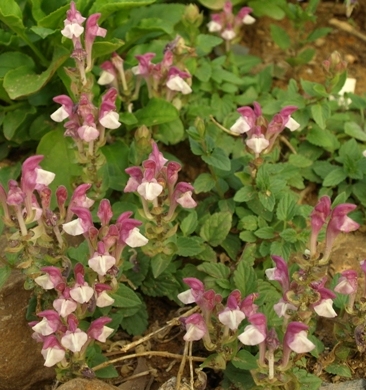
Scutellaria is a genus of about three hundred species, including mostly
annuals and herbaceous perennials, and a few subshrubs. They are
distributed widely across the temperate regions of the planet, and also
occur in tropical regions at high altitude. They are classified in the huge
mint family (lamiaceae), and feature
the characteristic square stems (most noticeably in the more robust-growing
species), but unlike many of their cousins, they're not known for their
fragrance.
The genus name derives from the Latin word scutella, which means a little
shield, dish or saucer - describing the little dish-like fruiting bodies left
behind when the flowers fade. The common name refers to the flower itself,
whose bottom calyx resembles a tiny medieval helmet.
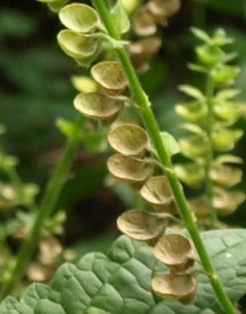
the little dishes I doubt scutellaria will ever be the object of massive gardening passion,
like roses, hostas, daylilies, or even cranesbills.
But I've developed a low-level collecting habit towards the genus - I'm
intrigued enough to attempt any new variety that comes my way through seed
exchanges. Through the years, I've tried my hand at many - not all
successfully, mind you. Expect to see updates to this page as new ones enter
our garden and strut their stuff!
I'll be describing the skullcaps growing in our garden in the rest of this
page. Nearly all of them came from seed that I received in trades and exchanges;
it is quite possible that my identification is off for a few species. If you
see any evidence of mis-identification, please let me know using the email
link at the bottom of the page!
Habit and cultivation
The statures of scutellarias growing in our garden range from little
ground-hugging things to medium-height upright plants - none much taller than
about two feet. Some of them have been downright easy to keep alive and
happy, while others seem to fade quickly. I've not yet figured out if that's
because of natural differences in life span, or because I failed to provide
the proper conditions for the species in the latter group to thrive.
The skullcap that's graced our garden longest is S. incana, which we
picked up a the Bowman's Hill wildflower sale many years ago. It still happily
occupies the same space in our garden; every year I'm afraid it finally gave up
(it's late to return in spring), but so far so good. Another one with
staying power is S. altissima - although I'm not sure if it's the
original plants that keep returning, or whether their place is taken by their
generous offspring. In any case, our patch remains strong year after year.
The smaller varieties have been shorter-lived, in my experience. S.
baicalensis was among the first we tried. It's gorgeous, but only lasted
two or three years. Several attempts to re-establish it were unsuccessful
(I think it insists on good drainage, which I cannot always provide), but
finally this year we have flowering plants again. Even smaller is S. pontica,
which defied its billing as a perennial, behaving instead as a biennial for us.
So I'll be experimenting with placement in years to come. One skullcap,
the little woody-stemmed S. alpina, has already made its way into our rock garden, which provides
the best-drained conditions our garden can offer. This may also be the best
location for S. baicalensis, S. orientalis, and S. scoridifolia.
On the other hand, some like it wet - most notably, S.
galericulata (marsh skullcap) grows along the waterside; we have ours planted
in a pot set right in our big pond's filtration bog, where its soil is
consistently wet. It seems quite happy there.
Nearly all of the information and photos on this page are from our
Pennsylvania garden, and describe plants that we have long since left behind.
But thankfully, I've found a few skullcaps that tolerate the Texas Gulf Coast
climate to which we have relocated. S. suffrutescens has been short-lived
but quite nice, lasting two or three years at a time, making it worth repurchasing
occasionally. And S. ovata, which I failed to get going in Pennsylvania,
turns out to like the Texas heat just fine, expanding nicely in the first two
years in our baking border.
Propagation
All of my skullcap multiplication efforts proceed via seed. I wish I
could give you a single method for germinating scutellarias, but it's not that
simple. Some species germinate easily and in great numbers; others only
grudgingly yield a seedling or two from multiple attempts, even after lengthy
cold treatments.
I've had reasonable success germinating S. altissima and S. pontica without
any cold treatment. S. baicalensis I've given about two weeks cold before
germinating at room temperature. All others have been more recalcitrant; I have
come to accept that S. incana needs about three months cold - given that
treatment, it germinates nicely when returned to room temperature. The same
probably holds for several other species that have been reluctant to sprout
for me.
I share all of the detailed information on my germination attempts on the
portrait pages for the individual species (linked in the captions of the tables
below). Eventually, I hope I'll be able to provide good directions for a larger
number of species.
Oh, the seeds themselves? Little dark balls. The fall out of their scutellas
easily, so be sure to harvest them not too long after they ripen - which is
when the dishlets turn crispy - tan or brown. I don't have enough of an
experience base to know how long the seeds remain viable - but in at least one
case (for S. baicalensis), year-old seed germinated fine, while the same lot
a year later failed to germinate at all. Fresher is almost certainly better.
The leaves
Skullcaps are not known for their brilliant foliage. But even though they
are mostly grown for their blooms, there's enough variety in leaf appearance
to take a closer look. On all members of the genus, leaves are arranged
oppositely (in pairs along the stems). All the ones we grow are leafless in
winter. The photos below illustrate some of the variety:
 |
 |
 |
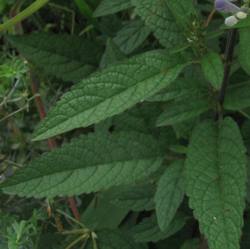
| Downy skullcap (S. incana) has crinkly,
elongated, gently serrated leaves in a muted shade of dark green. Attractive
without drawing attention to itself.
|
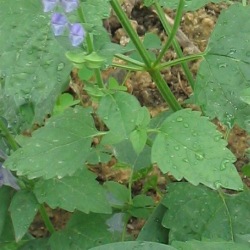
Tall skullcap (S. altissima) is apple-green,
with slightly sharper serrations on triangular to ovate leaves. A stand of these creates
a bright green swarm in the garden, looking good even when not in bloom.
|
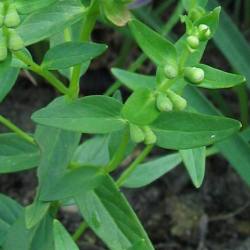
Chinese skullcap (S. baicalensis) features
smooth, entire-margined, mid-green leaves. Some of our plants (particularly
youngsters) have narrower leaves than shown here.
|
 |
 |
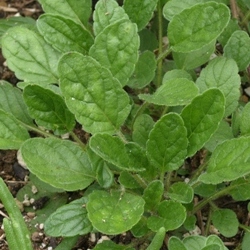 |
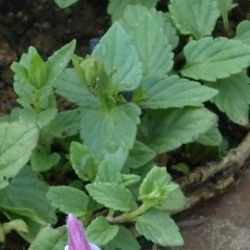
| S. orientalis makes a marvellous mat
of small glossy leaves, attractively serrated.
|
Alpine skullcap (S. alpina)'s woody
stems sprout small gray-green leaves - similar in shape but not size to those
of S. altissima.
|
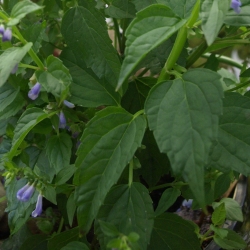
S. pontica, another low-growing
type, has small leaves with more gently scalloped margins.
|
 |
 |
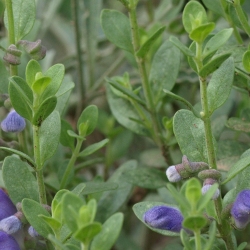 |
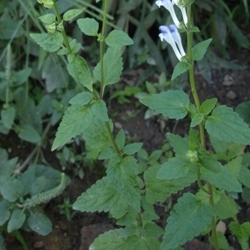
| Marsh skullcap (S. galericulata)'s leaves
are triangular and just a bit smaller than those of S. altissima - but slightly
pointier.
|
S. tournefortii) likewise has serrated,
roughly triangular leaves.
|
Prairie skullcap (S. resinosa) has small,
slightly felted, smooth-margined gray-green leaves.
|
 |
 |
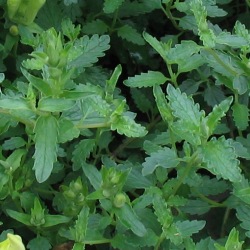
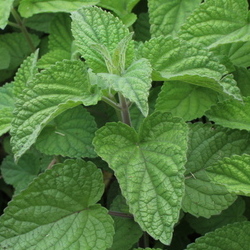
| Heart-leaf skullcap (S. ovata) sports
substantial crinkly leaves somewhat resembling mint, looking great massed
together in the border. |
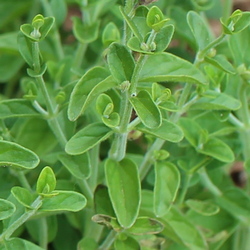
Texas pink skullcap (S. suffrutescens)
makes a nifty mound of tiny, somewhat glossy leaves. |
Flowers
Even though most of the diversity in appearance derives from the plants'
habits and foliage, the flowers are the primary reason most of us grow
scutellarias. Many of them, viewed up close, have a bit of a funny-face look
to them. It's the muppet show! The mini-gallery below shows some of the blooms:
 |
 |
 |
 |
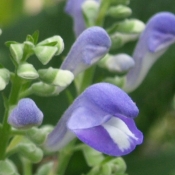
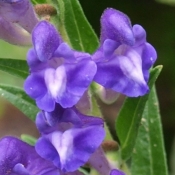
| S. incana sports bicolor flowers with a nice
contrast between clear blue and crisp white.
|
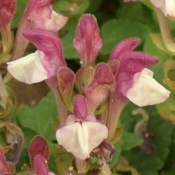
Another bicolor, S. alpina is quite a bit
different - not only in the rose color, but also the pattern and the way
the flowers are clustered at the stem tips.
|
S. baicalensis takes the bicolor thing
to a much subtler level - from a distance, they just look like a royal blue.
|
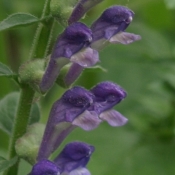
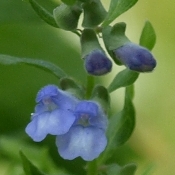
S. altissima continues the blue theme
in a slightly more muted tone, with flowers that are conspicuously arranged
in pairs along one side of the flowering stem.
|
 |
 |
 |
 |
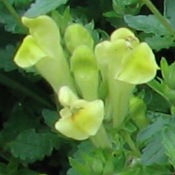
| Temporarily breaking up the blues, here's S. orientalis with its soft-yellow flowers held just barely above the leafy mat.
|
Returning to icy blue, S. galericulata also
sports the one-sided pairs look.
|
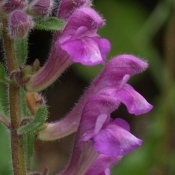
The magenta flowers of S. pontica are held along
one side of the stem, and show just a touch of white on their lower lips and
along their tubes.
|
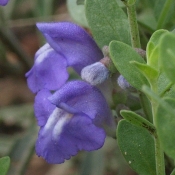
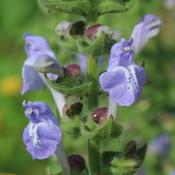
S. resinosa's flowers are pretty close
to a clear true blue, with subtle white highlights.
|
 |
 |
 |
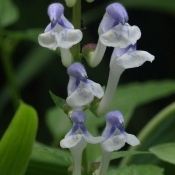
| Another cool blue, S. tournefortii pairs its two-tone flowers along one side of upright stems.
|
S. ovata carries its blue-with-subtle-white flowers
around stems that rise above the leaves.
|
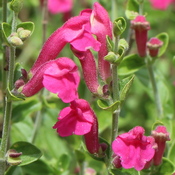
S. suffrutescens bears a profusion of
bright magenta flowers all around its foliage mound.
|
Other species
Roughly divided into two categories: those that I've tried to grow (but
failed), and those I've yet to try. In the first category we have S. diffusa,
a lavender-flowered annual and S. lateriflora (which has thwarted many of
my seed attempts). I thought I had S. woronowii,
but it turned out to be S. altissima (or so I believe).
In the not-tried category, 'Violet Cloud' is one of the few hybrid skullcaps I know of,
with deep-violet flowers. It should be hardy to zone 6 at least. S.
integrifolia is a US wildflower with narrow leaves and blue blooms. And
S. wrightii, another blue-flowered species, is native to Texas and
Oklahoma, so is on my let's-try list.
There are many more - these are just some of the more garden-worthy species
I'm aware of. If you have others to recommend, please use the comment form
below.
Further reading
Wikipedia entry with
some basic information about the genus.
The Curlie Directory's collection of links features mostly references
to photographs of various species.
A paper describing
possible medicinal uses, also including general, cultivation, and propagation
information.
Visitors to this page have left the following comments| Mike Baker | Oct 22, 2008 | I grow Scutellaria parvula, a native prairie species. I only gets about 6 inches tall. The flowers are unfortunately small. It does form a nice ground cover. I am currently letting mine go to see if a large mass of these plants will produce a better display.
Looks like a neat little plant that I wouldn't mind trying sometime. Adding it to my seed want list! |
| Annette Wright | Jan 01, 2009 | I love skullcaps and what you can bring to flower namely pontica and orientalis I cannot, they are evergreen here, certainly can recommend indica,formosona,ventenatii and tournefortii, these are all great, one of the best grape coloured ones is scutellaria javanica.
Cheers Annette |
| Nirmal Joshee | Feb 28, 2010 | I have many Scutellaria species and would like to exchange. I conduct research on their conservation and medicinal properties.
And yes, you have a wonderful site.
Thanks
Nirmal
Thanks Nirmal - I have replied by email. |
| Scott | Apr 09, 2010 | where can I get scutellaria galericulata and indica seeds? Can't find people selling these seeds on google. |
| Tom Bayer | Jun 13, 2010 | I simply goggled Scutellaria baicalensis and got your fantastic site. The information you have is invaluable. Just got the seeds from Hudson in California and needed that information on two weeks cold treatment. Only interested in medicinal properties at this point, but it appears to be a gorgeous plant as well. I live in Hillsdale, Michigan, which straddles Ohio and Indiana. Will take my time with your site. Beautiful! I also grow six species of bamboo. Gardening is a hobby as I'm retired. |
| ROBERTA | Jul 16, 2010 | Thank you for your very concise descriptions and photos, for now I am finally convinced I have a huge patch of Scutellaria altissima growing happily in my South Florida rose garden for the last 2 years. I don't know why my yard is ever changing, and I would miss this one if it does not return. It is a fantastic ground cover. Just one thing though- no one ever mentions the scent of the leaves...like lemon or grapefruit to me. Have you noted this as well?
Hi Roberta,
I just tried, and I didn't notice a strong scent - maybe a slight minty or anisey fragrance. So maybe what you have is slightly different from ours. |
| ROBERTA | Jul 18, 2010 | Well thank you for responding so promptly. Since there are so many species of Scutellaria, it is certainly possible this is somewhat different, though I am convinced from your photos that must be altissima. I will
just for fun send you a couple of photos. I believe you are the man when it come to a Scutellaria ID. I will like looking over the rest of your site as well. Thanks again! |
| Tony V. | Apr 26, 2011 | I appreciate your graphics and descriptions - all very good. I was searching for photographs of the seedlings and embryos of Scutellaria baicalensis Georgi when I found your site. I am interested to take the challenge to grow some of them from seed... in zone 8/9.
If you could include pictures of the young plants and seeds that would be tremendous.
I'll drop in from time to time to see what you have here.
|
| hermes | Mar 09, 2012 | Thank you for your informative website with such beautiful photos. It will be interesting to see if my mother with dementia can manage to grow S.lateriflora (she kills houseplants by the over-kindess of water). Guess I'll have to plant it outside a container, right in the earth. I was about to order seeds but based on your miserable results I will wait for seedlings from a mail order house and pay the price. I am insomniac and I find a decoction or infusion useful. Tastes good too. I am growing scullcap to add a third, and fresh rather than dried, level of potency to my tinctures of the same plant. I will grow S. Baicalensis for the colour as well. |
| Bryan | May 18, 2012 | Hi,
Nice job with all the photo's - the one (and perhaps most important) photo your missing is Sculleteria Lateriflora which is used medicinally in America. Apparently not all species of "scullcap" are related nor are they used the same medicinally....
I've tried to grow S. lateriflora once or twice (see my feeble portrait stub, but wasn't successful at growing them to maturity. |
| Catharine Gunderson | Feb 13, 2013 | I volunteer at the UC Santa Cruz Arboretum, and I have been wanting to find Skullcap in the wild for years. I heard it grows around here, but I may have found it as an ignored plant at The Arboretum yesterday. Too shady for it to produce flowers most likely, but it appears to be S. altissima or S.ggericulata. The leaves are very serrated, and from the specimen I collected, seem to grow opposite from each other. Under a Spruce tree's shade. i would love to know more about it, and will probably have to key it out (with help), as I don't want to take chances with a possible toxic species of Scutellaria as I lead herb walks, etc. The leaves have no scent, and they taste somewhat bitter. From the top leaves I picked, the stem doesn't seem to be square like the mint family. Do you have any ideas with what else I can try to i.d. it? I don't know if I will get help in keying it out, but I will try. Thanks. Love the pictures and the site. Cat (Catharine) |
| Louise | Mar 12, 2013 | I visited battery park NYC , just 2 weeks before the terrible floods, last october. I found lots of S.incana flowering and took photographs and a few seeds. I gave them 3 months of cold and sowed them in a cup filled with perlite and left in a warm, light spot. just 4 days on, I notice the first green bits appearing. am so excited. I live in the netherlands and assume our climate to be much like that in NYC, so can hardly wait for our spring to arrive and my young plants can grow on under natural circumstances. they will remind me of a wonderful holiday and I will probably never know whether the parent plants survived this terrible disaster.
Good luck with the babies. I bet their parents are doing just fine, too. |
| Randy Collins | May 30, 2015 | Thank you for your informative website devoted to Scutellaria....my first intro to this wonderful genus was because of it's parentage in the Lamiaceae family. We
have the white-tailed deer so abundantly in our area and they seem to not like
many of the genera in the Lamiaceae group. My first attempt with Scutellaria was
with S. integrifolia. This plant grows very nicely in our South Carolina garden.
I am now trying S. baicalensis and want to try other species as well. Thanks again for your insightful material on these plants. |
| Mia | Aug 03, 2015 | I have a S. baicalensis plant that I just grew from seed earlier this year. It has flowered and I see the little disks you were talking about. When do I actually harvest them from the plant? Should they be green, brown or does it matter? Also, I assume the actual seeds are inside the disc? Is there anything I should know about opening it to get the seeds out? I appreciate the insights!
Wait till they are tan/brown. At that stage, you can easily strip them from the stems into a container. A little further crushing will release the small round seeds from the disk pouches. Don't wait too long, or they will self-release. I typically wait till most of the disks on a stalk have turned brown (with the top ones still green). |
| Kalie | Sep 21, 2015 | I have found that we have a very abundant supply of skullcap growing wild. Not sure what we should or could do with it.
I'm not aware of anything you should do with it besides enjoy its appearance. It's in the mint family, but I'm not aware of any culinary or medicinal use. |
| Eliot | Jul 12, 2017 | Hello from the top of the South Island, Aotearoa New Zealand - where Scutellaria novae zelandiae is one of the highest risk plant species (Nationally Threatened status). I have been replicating some through simple vegetative propagation, bu am interested in germinating some of the (very tiny and sparse) seed I've collected this year. Many thanks for your informative site.
Thanks for writing, and good luck with your conservation efforts! |
| Lymester | Feb 15, 2018 | For germination try putting them into a small plastic consider with holes poked on the top & bottom. Have some good soil in the container. Moisten it daily for 2-6 weeks. Place the container in a constantly warm spot. Open the container regularly to exchange some air. Good luck. Transplant the plants before they grow too large |
| Hermes | Oct 06, 2018 | Half my container garden is scullcap (S. lateriflora). I tried both methods -- buying as small plants (because I killed so many by sprinkling fertilizer) and starting indoors as seeds. I am an inexperienced gardener in zone 8a (Vancouver area of Canada). Lack of sun (days without overcast) in all seasons but summer is common here. Rain is moderate. Drizzle is normal.
Results...
1. S.l. is a bit fussy compared to other plants in the mint family (e.g. spearmint) Some plants just don't do well, others thrive. I have no idea why.
2. The bigger containers (width) did better.
3. There is quite a variety of plant and leaf size and leaf colour (different shades of green)
4. It is very easy to accidentally break an entire plant off when weeding etc. The stem is fragile and handling the sort of like bamboo knobs can easily break them off
5. The roots grow like crazy and come up even after cutting off entire plants at the exposed stem
6. It has a pleasant bitter taste and both dried and fresh a mild alfalfa-like aroma
7. Hung to dry to shrink a quite a bit.
8. Like other mints they send runners.
9. S.l. grows slower than mint but faster than hyssop
10. Unlike mint, S.l. grows up from one small stem. Then it bushes out.
11. Flowers are extremely small. I would not call them 'showy'
I make vinegars, oils and tinctures because I find S.l. to be an effective nervine. Much better for me than five other herbs I tried.
QUESTION: We rarely get much snow here (there have been exceptional years recently), and then usually in Jan-Feb. How should I over-winter these plants? I would rather not start from scratch next year. I have no garage and barely any space at all on my patio. All I can think of doing is moving them closer to house and covering with mulch. Suggestions?
Thanks for sharing your experience. I tried S.lateriflora, but never got it going properly. Not sure why, but this species likes moist to wet soil, so perhaps I allowed them to dry out during spells of drought. In any case, according to the Missouri Botanical Garden, S. lateriflora is a perennial hardy to zone 3, so you should have no problem at all keeping it alive through winter. |
| Gilbert G | Mar 17, 2021 | Very nice site you have put together. Thank you. |
I welcome comments about my web pages; feel free to use the form below to
leave feedback about this particular page. For the benefit of other visitors
to these pages, I will list any relevant comments you leave, and if
appropriate, I will update my page to correct mis-information.
Note that I discard any comments including
html markups, so please submit your comment as plain text. If you have a
comment about the website as a whole, please leave it in my
guestbook. If you
have a question that needs a personal response, please
e-mail me.
Last modified:
April 02, 2024
Contact me
|